Friday, 13 May 2011

The two magic's, memes and technology affordances - a case for purposeful appropriation

Two Magics
Way back in 2007 Tim Berners-Lee spoke about the two magics - the phenomena associated with the fact that the web - an artificial construct established by a set of microscopic rules has macroscopic outcomes.
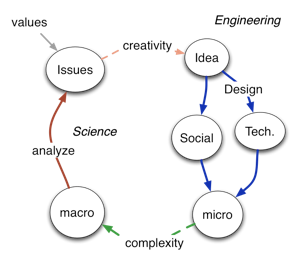
Tim Berner-Lees's Two Magics

Briefly the concept of the 'two magics' is associated Tim's concept of 'Philosophical Engineering'. The magics are a manifestation of the observation that the web is a socio-technical system in which we observe many different emergent phenomena where there is a cycle of inter-related developments.
The technology is engineered - a system is designed and implemented and we observe social and technical impacts.
Depending on your perspective the way in which the social and technological interact can be interpreted different ways (see Halford et al, 2010 'Towards a manifesto for web science', for some insights into this debate)
Tim states that the term 'magic'  is used as a short hand term to label 'stuff you don't understand' (yet)
The bit of this idea which I am thinking about now is that, we observe that some of the phenomena associated with the web work and unexpectedly go viral.


My Perspective - affordances and internet memes - a case for purposeful appropriation
Generally my approach to understanding and analysing change and the interactions between technology and society takes a 'technology affordances' perspective after Gaver (1991, 1996). But more and more I am developing the idea of promoting 'Purposeful Appropriation'. The idea is similar in some ways to the idea of modelling behaviour - but of course I am not talking about behaviour I am talking about ways that we successfully use the web. With purposeful appropriate you observe some successful phenomena on the web. You analyse the underlying drivers for that success, you purposefully take (appropriate) the same approach, but you apply it in a different field, perhaps with additional insights which are appropriate to the new field.
Consider the case of Facebook. They observed that google made money by selling advertising as a side activity associated with the purpose for which people were drawn to their site. They also understood that in the advertising world demographics is valuable. Their social network initially constrained the demographic of their population (university grads at successful institutions), subsequently they have but significant effort into gathering data on the demographics (and behaviours) of their users, which they can use to target/personalise the adverts which are presented to their users, and presumable thereby achieve a better hit rate and higher advertising revenues.
We observe that ideas and behaviours spread in a way that is associated with the internet. Sometimes those are in the area of jokes or fashions like RickRolling or LOL Cats. Susan Blackmore popularised the idea of memes in her book on the topic, and had extended the ideas talking about Internet memes and technology memes (Temes).
You can find a few links to memes and accounts of their role knowyourmeme.com, memedump.com, or  memebase.com
But we also observe that 'Google' has become a verb, and as such it is a a term which encapsulates a set of behaviours and assumptions which has behind it a model and expectation of the way our information world exists both in the physical and virtual. We observe in many different ways that the internet, mobile communications and technology infrastructures - and the need to solve particular problems give rise to varied and interesting solutions. What I want to do is to think about the fundamental technology affordances which are associated with these solutions and see how they can be applied in the area of social and educational innovation away from their original context.
For this reason I find it useful to follow a fairly mainstream podcast from the BBC where the correspondent Peter Day looks at change and business across the world. The ideas and phenomena which are being reported are not in the research lab, they are being used and apparently they work - which is what makes them interesting - to some extent they have already moved from the micro to the macro. Which means they might be worth appropriating in another context!
Links and examples:
Peter Day's podcast  is an easy way of stumbling across interesting snippets, he gets to a whole lot of places....
http://www.bbc.co.uk/podcasts/series/worldbiz
Peter Day's Podcasts - interesting series of programmes which often addresses new business models - eg micro payments in indian subcontinent, credit unions and affordable business loans in developing countries
An example of language translation
Not sure where I picked up this story originally, but there is some interesting use of mobiles and micropayments for translation services in africa
The same story was also featured in this blog, which is all about crowdsourcing :-)  the latter article also have various links to related writings.
refs
GAVER, W. W. (1991) Technology affordances. Proceedings of the SIGCHI conference on Human factors in computing systems: Reaching through technology. New Orleans, ACM Press.

GAVER, W. W. (1996) Situating Action ii: Affordances for interaction: The social is material for design. Ecological Psychology, 8111-130.
BLACKMORE, S. (2010). Dangerous Memes; or, What the Pandorans Let Loose. Cosmos and Culture: Cultural Evolution in a Cosmic Context. S. Dick and M. Lupisella, NASA: 297-318.

Wednesday, 11 May 2011

pecha-kucha at PLE_SOU

Folk may have missed the deadlines for submitting a paper to PLE_SOU but there is still a chance to submit a pecha-kucha (or poster demo) or just register and join in our media-cast contest. I've just uploaded a set of slides for the pecha-kucha call to slideshare (and you can take a look at my previous post on it too).
The hard work of folk like Ricardo Torres, Graham Atwell, Cristina Costa and Ilona Buchem - plus the unbridled enthusiasm of the conference participants meant that the first conference,  #PLE_BCN established a particularly high standard, for engagement, scholarly contributions and all round good fun!
So we are looking for a big dose of enthusiasm, imagination and creativity from this year's participants to match and even exceed our previous highs. The conference was also very international drawing experts from across Europe, North America and Australasia. Search YouTube with PLE_BCN to get a sense of the spirit.
So far the quality of paper proposals has been high and we are very keen to extend the community as far as possible. You can keep up to date with news and progress by following us on Twitter, and the conference promises to have a lively back channel enabling real-time interaction between attendees and those who can't make the event.
For more info on the media-cast, posters and demos you can go to the PLE_SOU website http://www.pleconf.com
You can also go along to Vimeo and join the PLE 2011 Group at Vimeo ready for the MediaCast
Come and join our vibrant community Southampton, UK July 11-13 #PLE_SOU. We are looking forward to it.
PLE_SOU conference details

Getting to grips with French/Latin - Romanes eunt domus -> Romani ite domum

Faced with translating the latin inscription on the 18th century Arc de Triomphe in Montpellier raised memories and debate on latin grammar. Along with recollections of innumerate latin masters, behaviourists who tried to modify students' behaviour by the local application of dictionary to head (with heft) we fondly recalled from Monty Python‘s Life of Brian


Lo and behold, I have just stumbled on a blog from a fellow computer scientist which cites just that scene - so thanks to @handee whose (unrelated) tweet led me there, and to  @tomcrick for citing the relevant source on his blog

http://drtomcrick.wordpress.com/2011/04/23/romanes-eunt-domus/


[Brian is writing graffiti on the palace wall. The Centurion catches him in the act]
Centurion: What’s this, then? “Romanes eunt domus”? People called Romanes, they go, the house?
Brian: It says, “Romans go home. “
Centurion: No it doesn’t! What’s the Latin for “Roman”? Come on, come on!
Brian: Er, “Romanus”!
Centurion: Vocative plural of “Romanus” is?
Brian: Er, er, “Romani”!
Centurion: [Writes "Romani" over Brian's graffiti] “Eunt”? What is “eunt”? Conjugate the verb, “to go”!
Brian: Er, “Ire”. Er, “eo”, “is”, “it”, “imus”, “itis”, “eunt”.
Centurion: So, “eunt” is…?
Brian: Third person plural present indicative, “they go”.
Centurion: But, “Romans, go home” is an order. So you must use…?
[He twists Brian's ear]
Brian: Aaagh! The imperative!
Centurion: Which is…?
Brian: Aaaagh! Er, er, “i”!
Centurion: How many Romans?
Brian: Aaaaagh! Plural, plural, er, “ite”!
Centurion: [Writes "ite"] “Domus”? Nominative? “Go home” is motion towards, isn’t it?
Brian: Dative!
[the Centurion holds a sword to his throat]
Brian: Aaagh! Not the dative, not the dative! Er, er, accusative, “Domum”!
Centurion: But “Domus” takes the locative, which is…?
Brian: Er, “Domum”!
Centurion: [Writes "Domum"] Understand? Now, write it out a hundred times.
Brian: Yes sir. Thank you, sir. Hail Caesar, sir.
Centurion: Hail Caesar! And if it’s not done by sunrise, I’ll cut your balls off.


all of which makes my current french homework feel rather more straigthforward - now back to the todo list, and bad girl for being distracted by twitter

Wednesday, 27 April 2011

Web Science: History Glitches and a Manifestos - a few references for today

Paul_Marie_Ghislain_Otlet.jpg
The role of Paul Otlet in the precursors to the web and the history of information science is not well known. I came across this information some years ago, but was delighted to find it again today while reading a couple of web science papers from last year's conference in Raleigh.
so today's treasure is...
van den Heuvel, C. (2008). Architectures of Global Knowledge: The Mundaneum and the World Wide Web. Destination Library , 15, 48-53.

Francophone Roots for the web? some observations
You can pitch over to wikipedia for more info on Otlet and the Mundaneum interesting to think that along with Minitel and Reuters this is part of the francophone history of the web.
interestingly there is a different account of Otlet's life from the french version of wikipedia - which since I am currently looking at plurilingualism and interdisciplinarity is highly relevant.

Web futurology?
The paper by van den Heuvel was referenced in 
Carr, L., Pope, C. and Halford, S. (2010) Could the Web be a Temporary Glitch? In: WebSci10: Extending the Frontiers of Society On-Line, April 26-27th, 2010, Raleigh, NC: US.

so thanks to Les Carr (aka @LesCarr and Repository Man) for that reminder, and thanks also for an interesting perspective on the web and web science.

This paper addresses the question of whether the Web that we currently enjoy is a permanent and fundamental phenomenon, or merely a fashionable popular enthusiasm for a novel kind of information sharing. I think in some ways it echoes the arguments which Malcolm Gladwell used in Outliers when he identified how various individuals in history have made achievements which are the combination of a particular set of contexts.  In this paper it is the contexts of academic practice and the open values which academia pursue accompanied by the emergence of open publication as a respected practice which have (in part contributed to the phenomena which we know as the web today).  For a deeper understanding, as ever, best read the actual paper :-)

Fabulous however, to reflect that this is the stuff which our undergraduate students experience as an everyday part of their degree courses in computer science at Southampton. 
And while we are talking about the interplay between research and teaching at Southampton University it there is some good stuff on interdiscpinarity to be found from the same three authors in

Halford, S., Pope, C. and Carr, L. (2010) A Manifesto for Web Science. In: WebSci10: Extending the Frontiers of Society On-Line, April 26-27th, 2010, Raleigh, NC: US.

A result no doubt of our Web Science collaborations in Southampton, in no small part due to the hard (interdisciplinary) work that all these folk put into our Doctoral Consortium in Web Science (which has fully funded places available for highly qualified applicants :-).
This paper takes on the discussion about how we realise the interdesciplinarity of web science and break out from individual discipline based research silos.
"Our aim is to provoke and stimulate debate and to move beyond superficial popular psychology and sociology (which envisages engineering human behaviour) and to challenge some of the ways in which social science has engaged with technology and technical actors. To facilitate this, and taking our lead from Donna Harroway, the paper sets out a radical manifesto for web science".
It also has quite a lot to offer when it reminds us of the need to find, use and respect research which come from research traditions and forms of discourse which are different to those with which we are comfortable and familiar.
Take for example the following quote
"For whilst we might all agree that Web Science cannot develop without inter-disciplinarity, we should be clear from the beginning that this is no simple matter. We need to be realistic about what we are getting ourselves into. There will be big challenges in making ourselves understood to each other and developing collaborative understandings will require us to leave the comfort of our disciplinary silos. But, the promise of new forms of knowledge and understanding that are bigger than the sum of our parts are gains worth working for".
For me this has echoes with the ideas of plurilingualism - a policy approach backed by the UN, UNESCO and the EU.

I think these the challenges and benefits of working and cross fertilising between linguistic cultures are as great as those promised by interdiscipliarity and web science. Furthermore, the web does not exist in a single language, nor should it be bound by the invisible philosophical and epistemological constraints which come with any one linguistic tradition.
Plurilingualism argues for the need to continue to recognise and support discourse in more than one language - because of the need to communicate between many different languages, to respect those for whom communicating in only one language is not an option, and to respect and value the different types of discourse which are enabled by different languages and to respect and value the traditions which are an integral part of each different language. (Byram 2006)

Meanwhile, searching out some reading for a PhD student, here is  something which I am sure is related in some way, I just stumbled across the essay (online) which Papert wrote as an introduction to Mindstorms. In some ways I see it as a bit of a technology affordances perspective and its added into my refs for today

Papert, S., (1980),The gears of my childhood Forword to Mindstorms: Children, Computers, and Powerful Ideas (Basic Books)

The quote (paraphrased) from mindstorms which sticks in my mind is to the effect that - the children in explaining how they are controlling the computer articulate (and thus concetise and formalise)  their understanding of the mathematics which they are trying to model.
........
references
  • Byram, M., Plurilingualism in Europe (2006) British Council
  • Carr, L., Pope, C. and Halford, S. (2010) Could the Web be a Temporary Glitch? In: WebSci10: Extending the Frontiers of Society On-Line, April 26-27th, 2010, Raleigh, NC: US.
  • Halford, S., Pope, C. and Carr, L. (2010) A Manifesto for Web Science. In: WebSci10: Extending the Frontiers of Society On-Line, April 26-27th, 2010, Raleigh, NC: US.
  • Papert, S., (1980),The gears of my childhood Forword to Mindstorms: Children, Computers, and Powerful Ideas (Basic Books)
  • van den Heuvel, C. (2008). Architectures of Global Knowledge: The Mundaneum and the World Wide Web. Destination Library , 15, 48-53.

Friday, 22 April 2011

Thinking Web Science

thinking web science is what I have been doing for the past few days, although its a constant backdrop to the research I do :-)
As ever, on a friday, I get a little peeved , when people who have hijacked the term web science  when talking about science on the web or using the web for political science - decide to publish their stuff - but hey.
More interestingly ( I think) is a bit of speculation about a few of the manifestations of web science....
I find myself fascinated by the way in which new business models have emerged with increasing persistence of the web. I observe that the hard nosed profit oriented organisations are learning from each other, but also small organisations, concerned with rural development and sustainability are also finding out about this stuff, and turning it to their advantage.
Frequently when I chat to people about the social impact of the web I give examples of how these gains are manifested, but I thought it was time I recorded this information - if only so that I can go back and refer to it myself again in future.  Some of them were not explicitly web science manifestations when they emerged, but are now mediated and accelerated via web-based communities.
One dimension of these activities is the power of the meme - ways in which ideas catch on, and how human beings are supremely adapted for extending simple ideas
so, what are the things I am thinking of?
short list to be elaborated with links and further info
1 - aggregated translation service in african countries where contributors are paid via micro payments to mobile phones.
2 - credit union style activites in india
3 - rural self education networks in india mediated by internet connections
4 - so calle "WI degree" common foundation, then negotiated curriculum
5 - dissemination of good practice to agricultural communities

... more later, supper now

Thursday, 21 April 2011

Web Science Curriculum Development - update

Our paper WSCD: Negotiating the Web Science Curriculum Development through Shared Educational Artefacts has been accepted for ACM WebSci'11
Southampton Web Science MSc ecs.soton.ac.uk


Abstract

The far-reaching impact of Web on society is widely recognised and acknowledged. The interdisciplinary study of this impact has crystallised in the field of study known as Web Science. However, defining an agreed, shared understanding of what constitutes Web Science requires complex negotiation and translations of understandings across component disciplines, national cultures and educational traditions. Some individual institutions have already established particular curricula, and discussions in the Web Science Curriculum Workshop series have marked the territory to some extent. This paper reports on a process being adopted across a consortium of partners to systematically create a shared understanding of what constitutes Web Science. It records and critiques the processes instantiated to agree a common curriculum, and presents a framework for future discussion and development.

The need to study the Web in its complexity, development and impact led to the creation of Web Science. Web Science is inherently interdisciplinary. Its goal is to:
a) understand the Web growth mechanisms;
b) create approaches that allow new powerful and more beneficial mechanisms to occur.

Teaching Web Science is a unique experience since the emerging discipline is a combination of two essential features. On one hand, the analysis of microscopic laws extrapolated to the macroscopic realm generates observed behaviour. On the other hand languages and algorithms on the Web are built in order to produce novel desired computer behaviour that should be put in context. Finding a suitable curriculum that is different from the study of language, algorithms, interaction patterns and business processes is thus an important and challenging task for the simple reason that we believe that the future of sociotechnical systems will be in their innovative power (inventing new ways to solve problems), rather than their capacity to optimize current practices.

ACM WebSci'11 is in Koblenz this year - and we are going to present a paper :-)
"Web Science is concerned with the full scope of socio-technical relationships that are engaged in the World Wide Web. It is based on the
notion that understanding the Web involves not only an analysis of its architecture and applications, but also insight into the people, organizations, policies, and economics that are affected by and subsumed within it. As such Web Science, and thus this conference, is inherently interdisciplinary and integrates computer and information sciences, sociology, economics, political science, law, management, language and communication, geography and psychology".
Following the great news, our extended abstract proposal has been accepted, we are working on the final version of the paper we will present. You can find out abstract in EPrints. Students who are interested in following a PhD in Web Science can do so via our Doctoral Consortium which combines a preparatory Masters Degree with three years of intersdisciplinary study typically  supervised by a small team of academics representing the component fields of study.
Meanwhile, Michalis Vafopoulis, who is also part of our team, and who has been leading the subject categorisation initiative for the web science trust has made the outcomes of that work available via the Web Science Trust pages which was one of the outcomes of previous Web Science Curiculum workshops at the conference.
Along with the fact that Jim Hendler is convening Web Science Curriculum workshop at this year's conference, it looks like it is going to be a pretty good year for folk developing and teaching Web Science as an academic discipline.
....
Croitoru, M., Bazan, S., Cerri, S., Davis, H. C., Jonquet, C., Prini, G., Scharffe, F., Staab, S., Vafopoulos, M. and White, S. (2011) WSCD: Negotiating the Web Science Curriculum Development through Shared Educational Artefacts. In: ACM WebSci '11, 14-17 June 2011, Koblenz, Germany. (Submitted)

ready for a mobile world?

The redoubtable Brian Kelly twittered the outcomes of a quick survey he had done of the Russell Group University's front page
"Are Russell Group Unis ready for the Mobile Web? Findings from the #MobileOK tool: http://bit.ly/eZ47Tv"
So when I cam across this (now old) xcd cartoon, i thought it was appropriate to put the two together

http://imgs.xkcd.com/comics/server_attention_span.png

Xcd server attention span


"Yesterday I attended Nominet’s launch event for the W3C UK and Ireland Office (and note that tweets containing the #w3cuki hashtag are available on TwapperKeeper). A number of talks covered the Mobile Web including “Mobile web: where diversity is opportunity” by Dr. Rotan Hanrahan, the Chief Innovations Architect of MobileAware.  Dr. Hahrahan informed the audience about that many assumptions about Web sites are based on desktop browser experiences and many of the assumptions are wrong in a mobile context.
This made me wonder whether the assumptions we have regarding the design and structure of institutional Web sites will be valid for mobile access.  The W3C have developed mobileOk which is “a free service by W3C that helps check the level of mobile-friendliness of Web documents, and in particular assert whether a Web document is mobileOK“.
Are the home pages of Russell Group Universities ‘mobileOK’, I wondered, or have they been designed and tested for desktop access only? Yesterday I used the mobileOK checker service to check the home page of the 20 Russell group Universities".
The results are given on Brian's web page.
http://ukwebfocus.wordpress.com/2011/04/19/are-russell-group-universities-ready-for-the-mobile-web/