Showing posts with label digital literacies. Show all posts

Tuesday, 31 May 2011

The Digital Cognitive Apprenticeship - afforded by a rich learning environment

The idea of talking about a digital cognitive apprenticeship arose around the time Hugh Davis and I made a presentation to the HEA Enhancement Academy team leaders meeting* in May 2011. Although the concept has much deeper routes linking back to the concept of university education providing a 'cognitive apprenticeship' time when I  was working with Microcosm across the university to provide 'a campus wide structure for multimedia learning'.

DigitalApprentice

Fast forward almost 20 years and the world is a lot more interconnected and a big focus for us is in terms of personal learning environments, where the title of our presentation was 'The personalisation of a learning environment: student-led connections online and offline'. The link will take you to the slides in ECS ePrints at Southampton.

The presentation in many ways was a chance to reflect upon and discuss our understanding of personal learning environments and the UK digital literacies agenda. We were particularly fortunate in having an audience drawn from colleagues who are actively involved in steering their institutions through change.

A lot of work has been going on to craft our own rich learning environment here at Southampton since I posted an account of what I mean by Rich Learning Environments late in 2009

Along the way, the University of Southampton has been among the front line of folk who have been surfing the open data wave - its a wave which is well on its way to becoming a veritable tsunami launched by Tim Berners-Lee's call for 'Raw Data Now' at his TED talk in 2009

We have been working with colleagues on creating a specification for our learning environment, and have reported on that project via a publication in the International Journal of Virtual and Personal Learning Environments (forthcoming) but a pre-print is available online from ePrints.

Our ultimate objective is to craft an environment which cultivates and supports situated and authentic learning with a community of scholars in a digital world.

We are seeking to harness the affordance of Web 2.0 and use linked and open data to integrate internal and external resources and services in a seamless manner.

We put a special value on enabling our academics to work with their students accessing authentic resources so that learning in their respective disciplines and fields of study can be situated.

We hold true to the idea that our university is nurturing a continually renewing community of scholars and again believe that we can craft the tools of social and (light) semantic web technologies to provide a platform which is agile to respond to changing and emerging techniques and technologies, a system which is fit for purpose in the 21st century.

We believe that our approach to situated and authentic learning addresses the agendas which are grouped under the headings of digital literacies, but we prefer to refer to the skills knowledge and understanding of a digital world. Hence our reference to the digital cognitive apprenticeship.

It is the role of universities to nurture the thought leaders and decision makers of tomorrow. Out students come to use with a mix of sophisticated and naiive understandings of the way in which they can use technology for their learning. If that was not the case, they would not be ready for a university education - we are no longer in an era when we believe knowledge is the prime objective (if that were ever true). Alvin Toffler was remarkably prescient when he observed that

"The illiterate of the 21st century will not be those who cannot read and write, but those who cannot learn, unlearn, and relearn",

our apprentices will, we hope, progress to master all of the essential skills, knowledge and understanding so they can step forward with confidence into whatever future they choose to pursue.

references

Casquero, Oskar, Portillo, Javier; Ovelar, Ramón; Benito, Manuel and Romo, Jesús. iPLE Network: an integrated eLearning 2.0 architecture from a university's perspective. (2010) Interactive Learning Environments, Volume 18, Issue 3 September 2010, pages 293 – 308

Fournier, Helena & Kop, Rita. (2010) Researching the design and development of a Personal Learning Environment, Proceedings of the 2010 PLE Conference, CitiLab: Barcelona http://pleconference.citilab.eu

O'Reilly, T. (2005). What Is Web 2.0 – Design Patterns and Business Models for the Next Generation of Software  http://oreilly.com/web2/archive/what-is-web-20.html

O'Reilly, T. (2007). What is Web 2.0: Design Patterns and Business Models for the Next Generation of Software, Communications & Strategies, 1(1),17-37 http://papers.ssrn.com/sol3/papers.cfm?abstract_id=1008839

Santos, C. and L. Pedro (2009). Sapo Campus: A Social Media Platform for Higher Education. m-ICTE 2009: Research, Reflections and Innovations in Integrating ICT in Education, Lisbon, Portugal, FORMATEX: Badajoz, Spain.

White S. (2009) Rich Learning Environments, University of Southampton http://shirleyknot.blogspot.com/2009/12/rich-learning-environments.html

White, Su & Davis, Hugh C. (2011). Making it rich and personal: crafting an institutional personal learning environment, International Journal of Virtual and Personal Learning Environments, In Press. http://eprints.ecs.soton.ac.uk/22030/

White, Su & Davis, Hugh C. (2011) Rich and personal revisited: translating ambitions for an institutional personal learning environment into a reality. In: The Second International PLE Conference: PLE_SOU, July 11-13th 2011, Southampton, UK. http://eprints.ecs.soton.ac.uk/22140/

Southampton’s SLE Project http://www.ecs.soton.ac.uk/research/projects/749

*You can find a blog post which talks about the event at The Auricle


Saturday, 30 October 2010

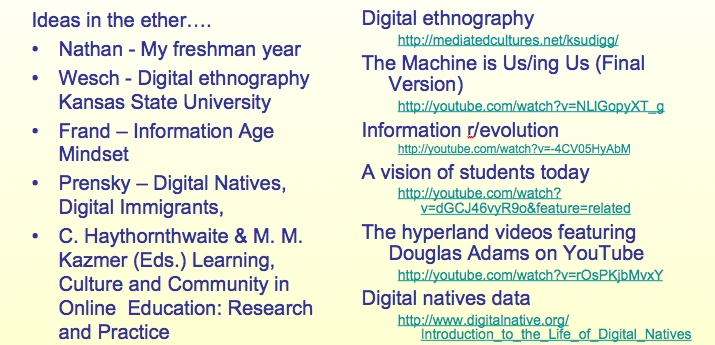
Readings digital literacies

- things have moved on since I gathered this set of references....
so probably best to search for some updates

Thankfully a lot of work has refuted the claims for digital natives :-) the world has moved on....

Picture 92.png


If nothing else, they reflect some of the ideas I am still coming across, I know that there have been a number of JISC publications, the learner experience work, and also Helen Beetham's work on Digital Literacies (refs needed)


Frand, J. L., "The Information Age Mindset: Changes in Students and Implications for Higher Education," Educause Review, vol. 35, pp. 15–24, 2000.
Haythornthwaite, C. A. and Kazmer, M. M., Learning, Culture, and Community in Online Education: Research and Practice: P. Lang, 2004.
Nathan, R., My Freshman Year: What a Professor Learned by Becoming a Student: Cornell University Press, 2005.
Prensky, M., "Digital Natives, Digital Immigrants," On the Horizon vol. 9, pp. 1-6, 2001.
Prensky, M., "The Emerging Online Life of the Digital Native: What They Do Differently Because of Technology, and How They Do It " Games2train, http://www.marcprensky.com/writing/Prensky-The_Emerging_Online_Life_of_the_Digital_Native-03.pdf 2004.
Wesch, M., " What Is Web 2.0? What Does It Mean for Anthropology? ," Anthropology News vol. 48, pp. 30-31, 2007.
Wesch, M., "Youtube Ethnography Project," Kansas State University http://mediatedcultures.net/, 2007.

Tuesday, 7 September 2010

Digital Literacies considered - Digital Discourses and Subject Specialisms

work in progress
Some reflections on the Digital Literacy Workshop at ALT-C 2010 - has tag #altc2010

Considering the prospect of convincing my academic colleagues to find space for Digital Literacy in the curriculum would most likely be taking on the task single-handed of pushing water uphill. If on top of that I was asked to devise an institutional strategy which helped put Digital Literacy at its core.


......
WIP - notes

use - visualise

http://twitterfall.com #altc2010
http://visibletweets.com

Tuesday
Donald Clarke's refs/ observations - uses the teaching of physics as a proxy for methods in lectures generally

The media equation - Byron Reeves & Clifford Nass http://www.amazon.co.uk/Media-Equation-Television-Information-Publication/dp/1575860538

Ferris Bueller's Day Out - video clip

(? of course how do you measure the discourse which is happening in people's head)

socrates plato and aristotle - ref to the philosopher's song - link to video

Newton - anecdote, lectured to empty classes
Feinnman - brilliant lecturerer - read the biography - read the preface to lectures in physics
Mazur - "Data is not the plural of anecdote" - (?narrative and hypnosis)


Thursday, 6 May 2010

Learning and Studying with Technologies - TELUSS

We can expect students at University to use a whole range of technologies in many different ways to help them learn and study for their degrees.

Academics are likely to be interested in this from two separate, but inter-related perspectives

1) Big Picture

What is the big picture view of current practice and the implications of this for the future long term development of practice in Higher Education?

2) Local Practice

What are the current practices and needs of our existing students in our own institutions - and how does this look compared to the big picture?

Hype vs Hope ( and truth and reality)

In addressing this we need to be able to :

sort out the hype of behaviours

challenge headline grabbing ideas and stuff that sells books

Beware of the hyperbole of moral panic, alarmism, and generalisations based on the leisure habits of time-rich young people

Find evidence from the reality of practice


Remember that


The behaviours of our students are likely to be constrained by time and driven by pressing imperatives

The needs and purpose of university education includes introducing learners to new ideas, and equipping them with multiple literacies, not least digital literacies


Question:
You probably already use technology in many different ways to help you learn and study for you university degree what three changes would you suggest the University introduce which would make a real difference to that aspect of your study at Southampton.