Wednesday, 13 April 2011

from tragedy to joy - the real story of the commons

some thoughts and thanks to Alan Dix - as is so often the case there seems to be synchronicity in the atmosphere :-)
I'm doing some background work for a paper we have on the stocks just now and was doing a bit of tidying and reference chasing and context setting.
Southampton Common Frosty Morning: Su White


Sunrise - a frosty morning on Southampton Common
in the process I came across a short but compelling post from Alan Dix on "the *real* tragedy of the commons"
I’ve just been reviewing a paper that mentions the “tragedy of the commons”1 and whenever I read or hear the phrase I feel the hackles on the back of my neck rise.
Of course the real tragedy of the commons was not free-riding and depletion by common use, but the rape of the land under mass eviction or enclosure movements when they ceased to be commons.  The real tragedy of “the tragedy of the commons” as a catch phrase is that it is often used to promote the very same practices of centralisation.  Where common land has survived today, just as in the time before enclosures and clearances, it is still managed in a collaborative way both for the people now and the for the sake of future generations.  Indeed on Tiree, where I live, there are large tracts of common grazing land managed in just such a way.
It is good to see that the Wikipedia article of “Tragedy of the Commons” does give a rounded view on the topic including reference to an historical and political critique by “Ian Angus”2
The paper I was reading was not alone in uncritically using the phrase.  Indeed in “A Framework for Web Science”3 we read:
In a decentralised and growing Web, where there are no “owners” as such, can we be sure that decisions that make sense for an individual do not damage the interests of users as a whole? Such a situation, known as the ‘tragedy of the commons’, happens in many social systems that eschew property rights and centralised institutions once the number of users becomes too large to coordinate using peer pressure and moral principles.
In fact I do have some sympathy with this as the web involves a vast number of physically dispersed users who are perhaps “too large to coordinate using peer pressure and moral principles”.  However, what is strange is that the web has raised so many modern counter examples to the tragedy of the commons, not least Wikipedia itself.  In many open source projects people work as effectively a form of gift economy, where, if there is any reward, it is in the form of community or individual respect.
Clearly, there are examples in the world today where many individual decisions (often for short term gain) lead to larger scale collective loss.  This is most clearly evident in the environment, but also the recent banking crisis, which was fuelled by the desire for large mortgages and general debt-led lives.  However, these are exactly the opposite of the values surrounding traditional common goods.
It may be that the problem is not so much that large numbers of people dilute social and moral pressure, but that the impact of our actions becomes too diffuse to be able to appreciate when we make our individual life choices.  The counter-culture of many parts of the web may reflect, in part, the way in which aspects of the web can make the impact of small individual actions more clear to the individual and more accountable to others.
  1. Garrett Hardin, “The Tragedy of the Commons”, Science, Vol. 162, No. 3859 (December 13, 1968), pp. 1243-1248. … and here is the danger of citation counting as a quality metric, I am citing it because I disagree with it! [back]
  2. Ian Angus. The Myth of the Tragedy of the Commons. Socialist Voice, August 24, 2008 [back]
  3. Berners-Lee, T., Hall, W., Hendler, J. A., O’Hara, K., Shadbolt, N. and Weitzner, D. J. (2006) A Framework for Web Science. Foundations and Trends in Web Science, 1 (1). pp. 1-130. http://eprints.ecs.soton.ac.uk/13347/ [back]

There are some dimensions to this argument which I am in the process of clarifying in my head, so I thought it timely - another synchronicity, Alan Dix had just been the external examiner to one of our star EngD/PhD students Clare Hooper (supervised by another worthy blogster and academic Dave Millard)

Like Alan, I have some personal experience of commons.

My own common at home, when I am not on sabbatical in Montpellier is a fine local open space, site of scientific interest and well used place for thought and play. We are fortunate in Southampton of having many parks and open spaces, and I probably do some of my best thinking there.
As an academic in the University of Southampton, based in ECS we live breathe and eat the commons. We share our academic publications through eprints, our learning resources through EdShare, and are among those at the bleeding edge of open and linked data through activities such as open.soton.ac.uk.

Our research in Web Science is concerned in its interdisciplinary manner in not only the Technology, Engineering and Analytics of the Web but also to the web as a 'social machine'. This latter aspect is to my mind most interesting (and thus most important)  in the interactions between the social and the technological, the affordances which emerge and the artefacts associated with those affordances.
Understanding the power of the social, and having the skills, knowledge and understanding to engineer the tools of the web had enabled Southampton to realise small contributions such as the open data projects and its predecessors such as  eprints and edshare. It has enabled us to make our own contributions to the commons; we have put our wealth into the common ground, and we have turned our thoughts to why this should be done, and what beneftis accrue. We are lucky to attract scholars (who are also practitioners) like Professor Sir Tim Berners-Lee and Professor Stevan Harnad who make their own forceful contributions and who engage those in power with discussion on the way forward for the common good.

Here in Montpellier, there are open spaces and a socialist local government who are consciously endeavouring to engineer the city for the greater good. We see public transport subsidised and well used, large scale social programmes and experience the vibrancy of a young city which at its heart hums to the sound of human discussion rather than choking in car fumes.  Trying to understand this social entrerprise (and using the engines we have on the web) enabled me to find a fine wiki - wikisara which seems to have a collection of GPS routes of public transport networks from across France, and a resource which is far more useful than the static map, conscientiously produced by the good burgers of this fine town. it is a general observation that public mapping is one interesting social manifestation of the web, and projects like open street map and open cycle map are testimony to the fact these are not merely french phenomena (far from it)

At the same time as I appreciate the social use of wikis in france, I also experience the hegemony of the french publishing industry - observing the differences in online publishing models between france and the UK - and the extent to which you have to pay for stuff in france! I also note that the french take on web sites (reflected in much of southern europe) is far less concerned with form and function, but more often a frustrating content free showcase which seeks to limit the visitor's experience rather than offering them open information to explore and use.

I want to find out more about these differences in manifestations and web artefacts, and I want to begin to understand what causes some of these differences.

Here, the points made by Alan Dix citing Ian Angus have real strength. A simple shorthand - history is about power, and if we have commons as a part of our history, we also have the heritage of the forces of power and hegemony.
Some thoughts about the common land
  • Common Land when cleared was more useful to a single powerful person than to many less powerful individuals.
  • The powerful individuals changed the commons for their own specialised use
  • There was a finite supply of land which could be usefully converted from common land to personal use
Alan gives wikipedia as an example of commons emerging, and I have a PhD student doing some very interesting work looking at trust and the growth of wikis in different cultures.
hmmm... there is more to do and say, and I will be doing some more thinking about this one - thanks Alan, very useful :-)

    Friday, 25 March 2011

    Time for some chit chat - bring on the pecha kucha planning

    it all started with a little early morning reading
    "Just checked in on the pickled herring in the refrigerator at work. To my horror and relief, it's still there"
    I was intrigued
    "Settled on 3 ppt slides and a 3-member doo-wop group in identical red sequined dresses singing backup".
    I was hooked
    maybe I should have titled this post more than a red herring
    Redherring


    pechakucha, (literally translated from the Japanese as chit chat), twenty slides of twenty seconds (20x20) the CHI 20 second madness all coalesced during my run this morning....thanks to Cathy Marshal @ccmarshall and Mark Bernstein @eastgate and their animated herring conversation on twitter and to Cristina Costa @cristinacost from our PLE conference committee who will be organising the petcha-kutcha at #PLE_SOU
    I have contributed to pechakucha before, our LSL interns last year presented their work via a petcha-kutcha. I have organised poster pitches at conferences and for my students, but with the time and space of a sabbatical and a good run along the riverside I was able to bring together a whole load of ideas
    why?
    because (includes)
    • I think visually, and I am a great believer in the Cartier Bresson docrine that the photograph can capture a certain moment
    • I have been documenting my runs with pictures, and often my everyday life.
    • I sometimes subscribe to Tufts adage that "Powerpoint is evil"
    • I am tired of being subjected to Death by PowerPoint
    • Pictures are a step towards interlingularity
    • I have so many things I want to communicate
    • I always like as many people as possible to be involved in conversations
    • we are planning to offer a petcha kutcha session at PLE_SOU
    • I am already intrigued by the prospect of an animated herring and a doo-wop band
    • I once read that there was space for communicating computer science through the medium of interpretive dance
    • I have lots of things I want to communicate ( oh I said that before)
    so what are some those things?
    • What it is like coming to live in Montpellier
    • What I plan to do with my sabbatical
    • What I have achieved on my sabbatical
    • What we mean by Institution Personal Learning Environments
    • How personal learning environments have a place in the web science agenda
    • What I think web science is
    • What other (ordinary) people think web science is
    • What other (academic) people think web science is
    • What is happening with semantic technologies in higher education
    • The role of visualisation is communicating scientific ideas
    • What we are offering to staff, students and the whole university through the Southampton Learning Environment - its not just a system, its a mindset
    In addition I want to introduce PetchaKutcha into my teaching - as a discipline to myself (slides at the start of a lecture)
    • it will train me to develop my visual thinking skills
    • it will help me build up a repertoire of images
    • it will introduce students to the idea and practice of petchakucha
    I will also get my second year students to choose between a pecha kucha and a three minute poster pitch as a means of presenting their posters to the class
    so its a pretty hectic thing ( and it was a lot quicker thinking it than recording it)
    you can find examples of pechakucha on youtube and vimeo, and when they become rather boring, you understand the benefit of really getting down to the bare bones. However the best examples are stimulating, creative and highly communicative. Browse, search, observe - I hope, like me, you will try to learn and emulate the best, and hopefully produce some really riviting slide shows ( and of course if you want people to watch them on an iPad you had better make sure you don't record them in Flash!)
    now I need to jot down all those images I had in mind...
    Footnote:
    PechaKucha Night was devised in Tokyo in February 2003 as an event for young designers to meet, network, and show their work in public.
    It has turned into a massive celebration, with events happening in hundreds of cities around the world, inspiring creatives worldwide. Drawing its name from the Japanese term for the sound of "chit chat", it rests on a presentation format that is based on a simple idea: 20 images x 20 seconds. It's a format that makes presentations concise, and keeps things moving at a rapid pace.
    http://www.pecha-kucha.org/
    or as Wired would have it
    "The result, in the hands of masters of the form, combines business meeting and poetry slam to transform corporate cliché into surprisingly compelling beat-the-clock performance art".
    http://www.wired.com/techbiz/media/magazine/15-09/st_pechakucha

    Wednesday, 23 March 2011

    What is web science?

    This post is WIP as part of an exercise preparing for a symposium which we plan to hold in Montpellier some time in May. As I worked through the process I was reminded that a key topic in web science is provenance and trust. I also understand that web science is of course inter-disciplinary, but suggest that the phrase 'web science' is going through an extended period of "negotiated understanding of meaning".

    I am interested in definitions and explanations manifest via text, images and videos. I am taking the canonical web pages as coming from WebScience.org - and will provide links to various classic definitions, but at this stage I am also particularly interested in what people outside of the web science trust think web science is. That means I will be interested in the differences and similarities between the canonical and emerging definitions, and seeing if I can make any inferences from that data.

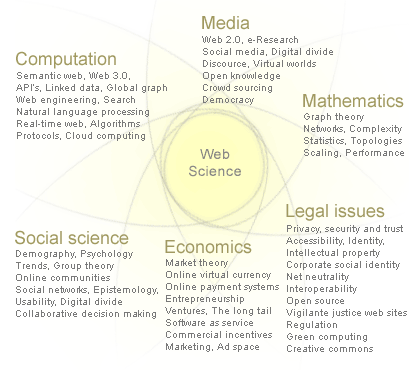
    Coming from Southampton, teaching on our Web Science Masters and having been at the finges of Web Science since its inception, I have a bit of an idea to begin with, and of course turn to the classic XXXX cluster diagram we all know and love.

    you can take the simple version

    Screen shot 2011 03 23 at 12 24 46

    or the more elaborate version

    Screen shot 2011 03 23 at 12 20 47

    Nigel Shadbolt's WebScience Cluster Diagram

    if you go to the web science trust facebook page you will find that people have been tagged within this diagram (ho ho)

    Nigel Shadbolt and Wendy Hall both have videos answering the question "What is Web Science?" and Les Carr has a slide share titled What is Web Science

    Taking the everyday approach

    I intend in subsequent posts to take a more measured academic approach to the definition. Meantime I am working on the sort of approach that I think an everday kind of person might use - search engines plus wikipedia. I am also only presenting generic information in this post. I plan at least two future editions

    1. educational/curriculum approach
    2. published research and current projects

    so if we try to find out what is web science, what are the various versions suggested?

    First take simple google searches, using web science, web science definitons, "web science" definitions

    I should note that I have been following a google search on Web Science as a search term for some time, and also have been tracking "web science" and "websci" on twitter.

    Also if I have already looked at this area in a posting on the 2010 Web Science Curriculum Workshop held in Southampton Last year

    Simple Searches

    www.fuzzzy.com is a social network which gathered its first members in November 2006. It describes itself as a social network for web science, includes collection of bookmarks, but unfortuantely the last time any were recommended by the editors was late 2010. Inevitably it suffers from spam postings, and simple bookmarking to links which are basically web applications. There are no

    it seems to have a strong european input, and its greatest contributor is one Janos Haits from Budapest, Hungary


    have some interesting visualisations which can be compared to the original sourced from the web science trustScreen shot 2011 03 23 at 11 21 53

    they also have a visualisation tool which is quite interesting

    Screen shot 2011 03 23 at 11 25 12

    Journals

    there are of course folk trying to get into the act by proposing journals - it is worth noting that journal.webscience.org is hosted by the WebScience Trust wiki and is a repository of proceedings from the Web Science conferences and other events which have been nominated by the WebScience Trust.


    for example

    Does not actually seem to be up and running yet, but I guess people are trying to get on the bandwagon.

    International Journal of Web Science  (IJWS) ISSN (Online): 1757-8809  -  ISSN (Print): 1757-8795


    Monday, 21 March 2011

    Time for some publications

    Bit of a round up on advice on where to publish and how to publish, seems timely revision, we are never too old to learn!
    Also thought this might be useful to friends, colleagues and of course PhD students.
    I have a couple of papers in the mix at the moment, and am on a mission to get some decent publications out there while I am on sabbatical at LIRMM in Montpellier, so its in focus for me just now.
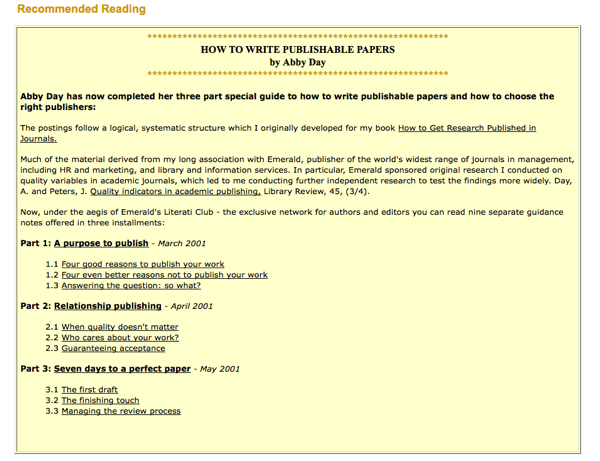
    Seems that Abby Day (formerly of Lancaster, and now based at the University of Sussex) got herself a bit of a reputation a few years ago advising people who to get published in Journals.  You can get a short version of her advice in a downloadable article titled How to write publishable papers you can see a snapshot below.
    Actually a bit more searching located all three parts of her advice via the author pages of  The International Education Journal: Comparative Perspectives (IEJ).
    Screen shot 2011 03 22 at 22 18 14
    Day points out that some of the empirical basis for the article's guidance are derived from research which was sponsored by Emerald which looked at the quality indicators of academic journals Day, A. and Peters, J. 1995 Quality indicators in academic publishing', Library Review, vol 45 no 3/4.
    Emerald, like many journal publishers has author pages which include a set of writings on the topic of how to get published and disseminate your work.

    My post was actually prompted by the fact that pubications are on the top of my todo list just now, and that I came across a (timely) tweet pointing me to a Prezi which claimed to be able to help "
    Screen shot 2011 03 21 at 16 10 01

    The source of this work is a researcher from Melbourne who tweets as the @thesiswhisperer (great handle isn't it) and who had a blog of the same name and is known in the real world as Inger Mewburn (again a distinctive handle, but perhaps less easily recalled).
    The prezi has
    • a few links to related work - a post on Publish2PhD
    • anatomy of types of papers
    • reference to helping Doctoral Students to Write, Kamler and Thompson (writing a tiny text)
    • writing a spew draft - links to a post about using scrivener to help in this process ( and had me resolving to take another look at tinderbox)
    • writing a scratch outline
    • cleaning the mess - clarify your ideas - may be itterative
    • murder your darlings (edit and revise)
    • leave it to relax/proove/rest (we are talking bread making analogies here) - critical friends too
    • this prezi is not too much like 'powerpoint on acid' - others can be. I find myself thinking how long did it take her to create that.....
    I think this post might usefully be linked to something I identified last year which was related to a learning technologies roadmap, and also various pieces on places to publish. More of that later...

    Refs:
    Day, A., 1996, How to get research published in Journals, Gower, Aldershot, UK
    Day, A. and Peters, J., 1995 Quality indicators in academic publishing', Library Review, vol 45 no 3/4
    Brown S., Black., Day A., Race P., 1998, 500 Tips for getting published: A guide for educators, researchers and Professionals, Kogan Page, London, UK


    Thursday, 6 January 2011

    Mendeley and repositories - pragmatics in a Web World

    I tried playing with Mendeley a good few months ago but did not feel I had particularly mastered the mechanics even if I thought I understood the principles.

    I was aware that Les Carr had written about Mendeley via twitter, but just as I am preparing for a sabbatical I am rather more focussed on what tools I need to use and master.  I guess in terms of web science this could be seen as "eating your own dog food". The bit of Web Science i find interesting is the emergence, place and role of "social machines" plus the observations of the way in which the technology and engineering of the web respond to social manifestations. Web 2.0 may have been copyrighted, but it was right there in Tim Berners-Lee's conception of the Read Write Web - as with so much of what we recognise in technology today the story is one of incremental distributed development from the bottom up, rather than grand design from the top down.  Although having the odd insight into the possible grand design is proving very useful :-)

    In that context I made the following comment on the previous blogs comparing Mendeley and Institutional Repositories which Les authored as Repository Man.
    .......

    Hmm.. I contrast Mendeley and IRs in a rather different way.

    An institutional repository where rich data is collected which enables the dynamic building of a sort of contour map of research (substitute or add other spheres of focus eg educational resources).

    For the individual researcher/teacher it generates a useful map of their home territory, but combined with other local researcher's deposits it shows estates, villages, cities. (although such visualisations only exist in my head - and there is something about Korbinky's the map is not the territory in there

    I use my IR because it's effectively a cloud server with overheads but it's part of my local infrastructure and I have to/need to/ want to use it a bit.

    The contents of Mendeley on my desktop (when I understand what I am doing) is the by product of my personal intellectual endeavours to note, observe, perhaps reflect and create order out of information I have processed as part of some research activity. it's the proxy for those photocopied collections of annotated papers of old. It's quite useful and reassuring if I can use it's tools on different platforms and then aggregate the results of those disjoint bits of effort.

    If I am lucky it may help to let me reason and derive or represent understanding.

    I use it If there is a low threshold to storing external info via Medeley i might  use it in the hope of getting some extra value from it.

    If/ when I master the tool then I can share and compare, perhaps add or contest my understanding if others have gone about using it in the same way as I have, in my particular sphere of interest. My collection becomes an artefact. The sets of collections a set of artefacts for discussion, but perhaps also mathematical analysis and or abstract reasoning.

    Of course it might be that my conception of Mendeley has been mediated by my need/compulsion to use my local institutional repository. And the understandings of IRs innate thus gained.

    Functionally I think of Mendeley as an alternative and potentially better solution to using a reference manager and some form of half cocked personal electronic 'librarianship'.

    I am planning to try to use Mendeley (again) because I plan to share my collections (content and abstract structure) with a few folk I can think of, but don't mind sharing with other folk too if they are interested. But that use will only be sustained if the overheads are low and I master it! If I am pressed and Mendeley is flakey I will stick with the half-cocked methods.

    I am not an evangelist of open sharing but I do have it as an objective which I would like to work - that may be about personal politics as much as being part of my academic identity.

    That same view prevents me being antagonistic to my IR even if I sometimes find it frustrating. I guess that with my IR, overheads and mastery within my control , so I knuckle down and use it.

    Tuesday, 14 December 2010

    213.251.145.96

    wikileaks has caused a bit of a furore
    you can look up what they are saying by going to 213.251.145.96
    or by checking out the various papers who have been granted access to the files prior to the leaking

    in some ways this seems to be following the protocol which the telegraph used to reveal info about MPs expenses in the summer of 2009

    sclater: RT @learninganorak: Julian Assange: Readers' Choice for TIME's Person of the Year 2010 http://t.co/1YT8EB6 via @TIMENewsFeed
    Original Tweet: http://api.twitter.com/1/sclater/status/14731574712999936


    Monday, 15 November 2010

    November 2010 CETIS2010 - notes

    draft notes

    CETIS 2010 Nottingham, November 15-16 2010

    The annual CETIS conference is another example of ways in which JISC has agency to support and enrich communities of practice operating in the field of technology enhanced learning in the UK.

    IMG_0156.JPG


    It's a few years since I last attended this conference; the community seems to have established a strong sense of identity since that time. Given the title of the conference "Never Waste a Good Crisis - Innovation & Technology in Institutions" and the financial onslaught on Higher Education lets hope that this strength stands it in good stead for the next few years.

    You can find the Programme online which will give you links and a sense of the dominant agendas.

    As with many conference the events were launched with a keynote, preceded by some welcoming remarks and a brief trip into a futuristic virtual higher education courtesy of Paul Hollins

    Keynote


    Anya Kamanetz, author of DIY University Edupunks, Edupreneurs and the Coming Transformation of Higher Education
    @anya1anya on twitter

    twitter visualisation link

    Options available parallel session day 1

    Open Innovation

    Relationship Management in HE and FE

    Cheaper, flexible, effective institutions: technology, politics and economics

    Integrating and Subverting Corporate Systems for Educational Purposes

    Next Generation Content

    My account will focus on Relationship Management . The session included presentations (contact Sharon Perry s.perry@bolton.ac.uk); a practical scenario based exercise led by Dr Qin Han; and an account of experiences from the Derbi project at the University of Derby presented by Jean Mutton

    Service Design references and Webliography

    taguclan a sort of rough guide to the University. Developed to help prospective students learn about the university, compiled by existing students, an example of collaborative authoring/co-production.

    twitter tag #rminhe
    JISC CETIS relationship managment website

    Those of you wanting to find out a bit more of the background to service design, may find the wikipedia entry on service design reasonably informative

    CETIS report on service design - from University of Derby

    Running notes on the presentation:

    These sessions arose from JISC funded projects looking at Customer Relationship Management and Student Life-cycle Relationship Management

    It can be seen as an example of applying commercial techniques to a higher education context. There already existing examples of the application of commercial techniques to public sector experiences - for example in the health service

    Example from Goldsmiths - spotting the pinch points - debugging processes. In their case it was found that small changes to service delivery can make much larger impacts across the piece.

    The initial thrust of the session was thinking about how we might use customer relationship management tools in an educational context. This actually applies to the frameworks for thinking and analysing how we optimise processes and deal with problems which are associated with the labrynthine procedures around the student experience.

    During the disucssion it was observed that issues do arise surrounding the conceptions of what Universities are about, terms like customer implies/belies the comoditisation of education. It was observed that there was less resistance with the use of the word client. Engaging in these sorts of processes may help a university articulate its values and crystalise what it expects to emerge as the outcomes of its processes and to thereby identify intended and unintended outcomes of processes.


    Part 2 - interactive session on Service Design

    principles underpinning the service design approach

    Part 3 - the DERBI experience

    Jean Mutton introduced an account of the experience of the DERBI project at the University of Derby which introduced service design at the University of Derby, The small scale project led to an interesting set of improvements for the student experience in relation the their experience of the enrollment processes. myderbi @ myderbi on twitter

    it seems to me that if we are talking about learning from business processes we might look to good experiences of the online interaction, and then see how we can incorporate such practices or model the interactions into our processes.

    Perspectives/Issues Discussed

    fail points

    heuristics for management
    spotting the fail points

    some discussion

    biographies


    Qin Han studied service design and communities of service for her PhD research

    Sharon Perry is one of the CETIS team

    Jean Mutton is the Student Experience Project Manager - DERBI Project - University of Derby

    Day 2

    Enterprise Data - Wilbert Kram
    Linked Enterprise Data in F/HE organisations stuff

    Damian Steer from the ILRT explaining how they make use of linked data in Bristol.

    http://researchrevealed.ilrt.bris.ac.uk/

    Paul Miller, Cloud of Data - Making Data Work account of a few up and running semantic web applications


    Particularly like the fact that he explained how Tripit works, and what its advantages are. Something I have been trying to say to Hugh for a bit of a while!

    SIRI - iphone app - only available in the states at the moment. Came out of a Darpa project -> apple

    PowerSet -> ms, bing

    Trueknowledge (UK) 200m

    Freebase - metaweb google

    Tripit not bought yet


    canonical source of community enriched data

    Seån O'Riain DERI NUI Galway

    Enterprise Linked Data - overview of the current deployment and extent of community

    ref - open society foundation open data study

    The report , commissioned by Open Society Institute’s Transparency and Accountability Initiative and written by Becky Hogge, provided insights on the UK and US processes to unlocking their data to their respective data.gov’s.

    http://www.soros.org/initiatives/information/focus/communication/articles_publications/publications/open-data-study-20100519

    http://www.soros.org/initiatives/information/about

    http://en.wikipedia.org/wiki/Becky_Hogge

    Tim Berners-Lee's five star scheme

    http://lab.linkeddata.deri.ie/2010/star-scheme-by-example/


    http://nlp.hivefire.com/articles/18041/the-role-of-community-driven-data-curation-for-ent/
    The Role of Community-Driven Data Curation for Enterprises
    http://www.springerlink.com/content/n057n28561m86vl6/


    Ref to challenges for financial data integration Edward Curry, Andreas Harth, Sean O'Riain Challenges Ahead for Converging Financial Data. In W3C Workshop on Improving Access to Financial Data on the Web

    http://sw.deri.org/2009/09/financial-data/

    Funnel-scaled.png


    ref http://www/w3.org/2001/sw/rdb2rdf/

    Feedback in Plenary: links and notes
    take a look

    Disruptive Innovation http://tinyurl.com/disruptive2010

    Absorptive Capacity: A New Perspective on Learning and Innovation
    Wesley M. Cohen, Daniel A. Levinthal; Administrative Science Quarterly, Vol. 35, 1990

    http://faculty.fuqua.duke.edu/~charlesw/s591/Bocconi-Duke/Papers/C10/CohenLevinthalASQ.pdf


    Designing Learning, towards a scalable interdisciplinary design science of learning

    ref - transforming american education - learning powered by technology


    Wang and Hannafin Design Based Research 1995

    socio-cognitive engineering: a methodology for the design of human-centred technology European Journal of Operational Research

    Socio-cognitive engineering: A methodology for the design of human-centred technology M. Sharples N. Jeffery, J. B. H. du Boulay, D. Teather, B. Teather and G. H. du Boulay