Showing posts with label research. Show all posts

Thursday, 16 June 2011

Walking, talking and thinking

If wisdom is the goal, then students must "walk 10,000 miles, read 10,000 books" said the 17th-century Chinese philosopher Gu Yanwu

stumbled across this quote on a piece in the times higher by Steven Schwartz

I love running, and one of the things I get out of running is time to think

I also love walking, and much of the pleasure I derive has some of the same source.  I enjoy being able to see the early morning sun, learn about my new surroundings, see the local flora and fauna, find a sense of space

And if

I also stumbled across some funded research which is researching walking in a thinking context working with PhD students

New Research Trajectories goes for a walk, gives you a sense of this activity

We used this sort of approach on an AwayDay the other year, and I am quite keen to organise an un-conference which uses walking as a device, I wonder if there would be much interest in the community?


Wednesday, 23 March 2011

What is web science?

This post is WIP as part of an exercise preparing for a symposium which we plan to hold in Montpellier some time in May. As I worked through the process I was reminded that a key topic in web science is provenance and trust. I also understand that web science is of course inter-disciplinary, but suggest that the phrase 'web science' is going through an extended period of "negotiated understanding of meaning".

I am interested in definitions and explanations manifest via text, images and videos. I am taking the canonical web pages as coming from WebScience.org - and will provide links to various classic definitions, but at this stage I am also particularly interested in what people outside of the web science trust think web science is. That means I will be interested in the differences and similarities between the canonical and emerging definitions, and seeing if I can make any inferences from that data.

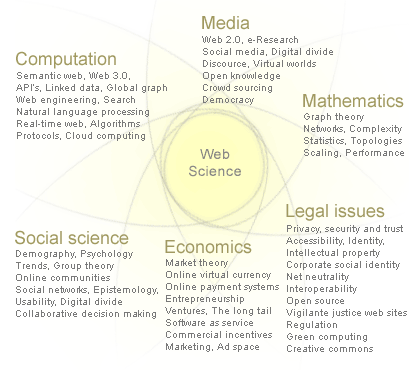
Coming from Southampton, teaching on our Web Science Masters and having been at the finges of Web Science since its inception, I have a bit of an idea to begin with, and of course turn to the classic XXXX cluster diagram we all know and love.

you can take the simple version

Screen shot 2011 03 23 at 12 24 46

or the more elaborate version

Screen shot 2011 03 23 at 12 20 47

Nigel Shadbolt's WebScience Cluster Diagram

if you go to the web science trust facebook page you will find that people have been tagged within this diagram (ho ho)

Nigel Shadbolt and Wendy Hall both have videos answering the question "What is Web Science?" and Les Carr has a slide share titled What is Web Science

Taking the everyday approach

I intend in subsequent posts to take a more measured academic approach to the definition. Meantime I am working on the sort of approach that I think an everday kind of person might use - search engines plus wikipedia. I am also only presenting generic information in this post. I plan at least two future editions

  1. educational/curriculum approach
  2. published research and current projects

so if we try to find out what is web science, what are the various versions suggested?

First take simple google searches, using web science, web science definitons, "web science" definitions

I should note that I have been following a google search on Web Science as a search term for some time, and also have been tracking "web science" and "websci" on twitter.

Also if I have already looked at this area in a posting on the 2010 Web Science Curriculum Workshop held in Southampton Last year

Simple Searches

www.fuzzzy.com is a social network which gathered its first members in November 2006. It describes itself as a social network for web science, includes collection of bookmarks, but unfortuantely the last time any were recommended by the editors was late 2010. Inevitably it suffers from spam postings, and simple bookmarking to links which are basically web applications. There are no

it seems to have a strong european input, and its greatest contributor is one Janos Haits from Budapest, Hungary


have some interesting visualisations which can be compared to the original sourced from the web science trustScreen shot 2011 03 23 at 11 21 53
they also have a visualisation tool which is quite interesting

Screen shot 2011 03 23 at 11 25 12

Journals

there are of course folk trying to get into the act by proposing journals - it is worth noting that journal.webscience.org is hosted by the WebScience Trust wiki and is a repository of proceedings from the Web Science conferences and other events which have been nominated by the WebScience Trust.


for example

Does not actually seem to be up and running yet, but I guess people are trying to get on the bandwagon.

International Journal of Web Science  (IJWS) ISSN (Online): 1757-8809  -  ISSN (Print): 1757-8795


Monday, 21 March 2011

Time for some publications

Bit of a round up on advice on where to publish and how to publish, seems timely revision, we are never too old to learn!
Also thought this might be useful to friends, colleagues and of course PhD students.
I have a couple of papers in the mix at the moment, and am on a mission to get some decent publications out there while I am on sabbatical at LIRMM in Montpellier, so its in focus for me just now.
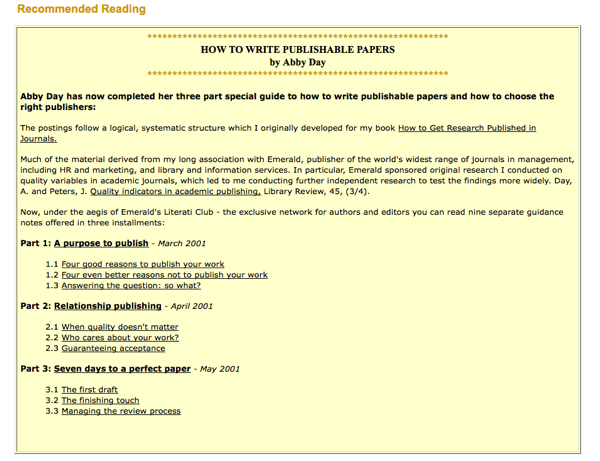
Seems that Abby Day (formerly of Lancaster, and now based at the University of Sussex) got herself a bit of a reputation a few years ago advising people who to get published in Journals.  You can get a short version of her advice in a downloadable article titled How to write publishable papers you can see a snapshot below.
Actually a bit more searching located all three parts of her advice via the author pages of  The International Education Journal: Comparative Perspectives (IEJ).
Screen shot 2011 03 22 at 22 18 14
Day points out that some of the empirical basis for the article's guidance are derived from research which was sponsored by Emerald which looked at the quality indicators of academic journals Day, A. and Peters, J. 1995 Quality indicators in academic publishing', Library Review, vol 45 no 3/4.
Emerald, like many journal publishers has author pages which include a set of writings on the topic of how to get published and disseminate your work.

My post was actually prompted by the fact that pubications are on the top of my todo list just now, and that I came across a (timely) tweet pointing me to a Prezi which claimed to be able to help "
Screen shot 2011 03 21 at 16 10 01

The source of this work is a researcher from Melbourne who tweets as the @thesiswhisperer (great handle isn't it) and who had a blog of the same name and is known in the real world as Inger Mewburn (again a distinctive handle, but perhaps less easily recalled).
The prezi has
  • a few links to related work - a post on Publish2PhD
  • anatomy of types of papers
  • reference to helping Doctoral Students to Write, Kamler and Thompson (writing a tiny text)
  • writing a spew draft - links to a post about using scrivener to help in this process ( and had me resolving to take another look at tinderbox)
  • writing a scratch outline
  • cleaning the mess - clarify your ideas - may be itterative
  • murder your darlings (edit and revise)
  • leave it to relax/proove/rest (we are talking bread making analogies here) - critical friends too
  • this prezi is not too much like 'powerpoint on acid' - others can be. I find myself thinking how long did it take her to create that.....
I think this post might usefully be linked to something I identified last year which was related to a learning technologies roadmap, and also various pieces on places to publish. More of that later...

Refs:
Day, A., 1996, How to get research published in Journals, Gower, Aldershot, UK
Day, A. and Peters, J., 1995 Quality indicators in academic publishing', Library Review, vol 45 no 3/4
Brown S., Black., Day A., Race P., 1998, 500 Tips for getting published: A guide for educators, researchers and Professionals, Kogan Page, London, UK


Tuesday, 10 August 2010

Potential Projects: Tools and Environments for Learning Potential Projects: Tools and Environments for Learning

As students progress through their education we observe that they customise and build their own learning environments bringing together sets of preferred tools in a manner which is individual and responsive to their personal needs.

The Southampton Learning Environment seeks to establish a framework in which to provide personalised and personalisable information and services.

Project students undertake dissertation work related to the Southampton Learning environment will have the opportunity to address challenging problems across a range of focus areas associated with the development of this exciting new environment.

Indicative areas include but are not restricted to

• Interface specification and design

• Linked data for interoperability

• Widgets to support learning

• Personalisation framework

• Widget container

• Id management framework

• Evaluation of learning environment tools

• Tools for research/visualisations

see also - something to read

http://shirleyknot.blogspot.com/2010/06/something-to-read.html

Wednesday, 9 June 2010

readings: Modified Delphi Technique

Delphi technique goes back to the Rand Corporation in the US just post 1939-1945 war, although I guess the reference to the original delpi (the ancient greek oracle) is indicative of the roots of this approach.

There is an intersting paper which exemplifies an early(ish) application of the modified delphi in the context of higher education.

Alfred R Hecht, A Modified Delphi Technique for Obtaining Consensus on Institutional Research Priorities. Research Brief. Paper presented at the Annual Meeting of the North Central Region AERA Special Interest Group on Community College Research, July, 1977
http://eric.ed.gov/ERICWebPortal/contentdelivery/servlet/ERICServlet?accno=ED140912

The paper is rather old, but reads quite well and is clear. Additionally its quite instructive to read a 1977 paper and see what it looks like! personally, I love the way that people like ERIC and ACM Digital Library are making digitisations of older papers available as PDF images.

As a more recent  (tho' still fairly old) paper which is relevant to modern day applications
Custer et all 1999 is useful JVTE v15n2: The Modified Delphi Technique - A Rotational Modification

The wikipedia ref is OK but probably not helpful to the typical undergrad working on a project.

Linstone and Turrof’s book is online (for which some of the chapters may be useful, but which is probably a bit too much for you to read http://www.is.njit.edu/pubs/delphibook/

Why use the modified Delphi?
  • Basically focus groups can be problematic
  • Members can skew the responses by influencing group dynamics
Delphi and modified delphi is also sometimes knows as quick consultancy

A useful brief account of the technique can be found in A Handbook of Techniques for Formative Evaluation By Judith W. George, John Cowan
  • It is possible to run it in either entirely remotely with deadlines on the voting and responses
  • Or to run it partly electronically and partly face to face, where you do the setup electronically, but then go through the consultation in a group in a fairly short time. 
  • Its a very efficient approach to get a good volume of evaluation data
Also worth considering - Nominal Group Technique - see wikipedia entry as a starting point

I plan to put some more info on my blog elaborating ways to use the approach, which will include a growing set of refs. You may also want to look at the TELUSS project

I would be interested in a student project to develop a tool to manage all the stages of the process of a modified delphi technique

Wednesday, 29 July 2009

Back To School

IMG_0783.JPG

Its always good for a teacher to go back to school. This year, in anticipation of setting up a sabbatical at a French University, I decided to go back to school and brush up my French. I was fortunate, in that I was going to be in Paris for a conference in any case for a conference.

Maybe its my personal preference, but I found a couple of weeks intensive study an excellent option. It gave me a chance to focus and refine my understanding, and once again I found myself musing on ways we could take an intensive approach in our regular courses at University.

So what was their recipe for success?
  • small classes with expert tuition
  • highly motivated learners
  • intensive, highly focussed topic area

Wednesday, 29 April 2009

Research Teaching Linkages


Thinking about the relationship between research and teaching

The linkages between research and teahcing a something which I have been working on for some time. I have had a few publications in the area already, have been conducting some surveys, and I am presenting a paper on the topic at this summers ACM ITiCSE to be held in Paris in July 2009. In addition I am part of the CPHC Learning Development Group, and its a special interest for them too. We are planning a workshop for later in the year (September/October).

This blog is prompted by a Workshop at Dundee University which was looking at Research Teaching Linkages.

As a part of the research the initiative has produced a report which includes a list of graduate attributes, a set of case studies, recommendations for changes in the curriculum which can cultivate stronger links between research and teaching.

Method
reporting on the work which has been done researching the relationionship between teaching and research in Scottish Universities. This work has been supported by the Scottish QAA
Activities included:
  • literature survey
  • desk survey
  • workshop
  • staff questionnaire
  • student questionnaire
  • interview
web site
has case studies, learning through research, learning about research, and both. The case studies cover maths and computing.

The workshop included presentations of some of the case studies, which gave further insight into the motivations and context of the ways in which colleagues integrate research and teaching. The examples were drawn from Computing and Maths.

Later year options in Computer Science investigated the activity of research projects

Mathematics - using mathematical modelling in cancer research, and fungal growth. Modelling is fundamental to mathematical research in Mathematical biology. The presented then spoke about the mathematical biology BSc, a range of modules were highlighted which build the research teaching links - in the early years the students learn the processes of research (predominantly) in the later units they learn and use the processes of research and learn to apply them. As they expressed it, both the context and content of research.
There are the following suggested students gains from linking research and teaching
  • enthusiasm and insight
  • knowing the state of the art
  • knowing the main players
  • being the main players
  • seminars, visitors conferences
  • phds and postdocs
  • interactions with industry
Observations from some of the the academics presented included beliefs that linking research and teaching,
  • enriches the curriculum through an up to date curriculum,
  • provides a meaningful link to pg studies,
  • and a meaningful link to employment.