
The role of Paul Otlet in the precursors to the web and the history of information science is not well known. I came across this information some years ago, but was delighted to find it again today while reading a couple of web science papers from last year's conference in Raleigh.
so today's treasure is...
van den Heuvel, C. (2008). Architectures of Global Knowledge: The Mundaneum and the World Wide Web. Destination Library , 15, 48-53.
Francophone Roots for the web? some observations
You can pitch over to wikipedia for more info on Otlet and the Mundaneum interesting to think that along with Minitel and Reuters this is part of the francophone history of the web.
interestingly there is a different account of Otlet's life from the french version of wikipedia - which since I am currently looking at plurilingualism and interdisciplinarity is highly relevant.
Web futurology?
The paper by van den Heuvel was referenced in
Carr, L., Pope, C. and Halford, S. (2010) Could the Web be a Temporary Glitch? In: WebSci10: Extending the Frontiers of Society On-Line, April 26-27th, 2010, Raleigh, NC: US.
so thanks to Les Carr (aka @LesCarr and Repository Man) for that reminder, and thanks also for an interesting perspective on the web and web science.
This paper addresses the question of whether the Web that we currently enjoy is a permanent and fundamental phenomenon, or merely a fashionable popular enthusiasm for a novel kind of information sharing. I think in some ways it echoes the arguments which Malcolm Gladwell used in Outliers when he identified how various individuals in history have made achievements which are the combination of a particular set of contexts. In this paper it is the contexts of academic practice and the open values which academia pursue accompanied by the emergence of open publication as a respected practice which have (in part contributed to the phenomena which we know as the web today). For a deeper understanding, as ever, best read the actual paper :-)
Fabulous however, to reflect that this is the stuff which our undergraduate students experience as an everyday part of their degree courses in computer science at Southampton.
And while we are talking about the interplay between research and teaching at Southampton University it there is some good stuff on interdiscpinarity to be found from the same three authors in
Halford, S., Pope, C. and Carr, L. (2010) A Manifesto for Web Science. In: WebSci10: Extending the Frontiers of Society On-Line, April 26-27th, 2010, Raleigh, NC: US.
A result no doubt of our Web Science collaborations in Southampton, in no small part due to the hard (interdisciplinary) work that all these folk put into our Doctoral Consortium in Web Science (which has fully funded places available for highly qualified applicants :-).
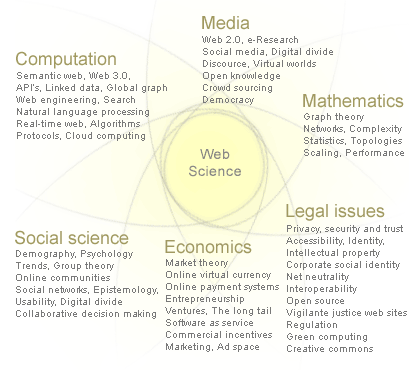
This paper takes on the discussion about how we realise the interdesciplinarity of web science and break out from individual discipline based research silos.
"Our aim is to provoke and stimulate debate and to move beyond superficial popular psychology and sociology (which envisages engineering human behaviour) and to challenge some of the ways in which social science has engaged with technology and technical actors. To facilitate this, and taking our lead from Donna Harroway, the paper sets out a radical manifesto for web science".
It also has quite a lot to offer when it reminds us of the need to find, use and respect research which come from research traditions and forms of discourse which are different to those with which we are comfortable and familiar.
Take for example the following quote
"For whilst we might all agree that Web Science cannot develop without inter-disciplinarity, we should be clear from the beginning that this is no simple matter. We need to be realistic about what we are getting ourselves into. There will be big challenges in making ourselves understood to each other and developing collaborative understandings will require us to leave the comfort of our disciplinary silos. But, the promise of new forms of knowledge and understanding that are bigger than the sum of our parts are gains worth working for".
For me this has echoes with the ideas of plurilingualism - a policy approach backed by the UN, UNESCO and the EU.
I think these the challenges and benefits of working and cross fertilising between linguistic cultures are as great as those promised by interdiscipliarity and web science. Furthermore, the web does not exist in a single language, nor should it be bound by the invisible philosophical and epistemological constraints which come with any one linguistic tradition.
Plurilingualism argues for the need to continue to recognise and support discourse in more than one language - because of the need to communicate between many different languages, to respect those for whom communicating in only one language is not an option, and to respect and value the different types of discourse which are enabled by different languages and to respect and value the traditions which are an integral part of each different language. (Byram 2006)
Meanwhile, searching out some reading for a PhD student, here is something which I am sure is related in some way, I just stumbled across the essay (online) which Papert wrote as an introduction to Mindstorms. In some ways I see it as a bit of a technology affordances perspective and its added into my refs for today
Papert, S., (1980),The gears of my childhood Forword to Mindstorms: Children, Computers, and Powerful Ideas (Basic Books)
The quote (paraphrased) from mindstorms which sticks in my mind is to the effect that - the children in explaining how they are controlling the computer articulate (and thus concetise and formalise) their understanding of the mathematics which they are trying to model.
........
references
- Byram, M., Plurilingualism in Europe (2006) British Council
- Carr, L., Pope, C. and Halford, S. (2010) Could the Web be a Temporary Glitch? In: WebSci10: Extending the Frontiers of Society On-Line, April 26-27th, 2010, Raleigh, NC: US.
- Halford, S., Pope, C. and Carr, L. (2010) A Manifesto for Web Science. In: WebSci10: Extending the Frontiers of Society On-Line, April 26-27th, 2010, Raleigh, NC: US.
- Papert, S., (1980),The gears of my childhood Forword to Mindstorms: Children, Computers, and Powerful Ideas (Basic Books)
- van den Heuvel, C. (2008). Architectures of Global Knowledge: The Mundaneum and the World Wide Web. Destination Library , 15, 48-53.




 Posts
Posts

