Showing posts with label repositories. Show all posts

Wednesday, 31 August 2011

Suggested readings - web science and repositories - the cat's whiskers*

Seems like a good time to post a selected reading list with links to papers that form a background to the Web Science Curriculum Repository (WSCR - pronounced whisker - think cats ;-)
CatsWhiskers
Madalina who has put in so much hard work on this project, and she is particularly fond of cats, so it seems appropriate
Anyway enough of the cuddly furry lolz stuff and onto the reading list...
Work that we are doing at Southampton on repositories is being led by Les Carr (aka repository man). ePrints is being delivered as a platform which is rich in technology affordances. ePrints is being used as the engine behind a number of educational repositories, hosted at Southampton, and at other universities, for example EdShare, HumBox and Language Box,  teachers on the Web Science programme at Southampton already use EdShare to store a large volume of materials, WSCR is a plan to collect Web Science resources across the community. In particular we intend that the artefacts within the collection will serve as a tool to 'emerge' the Web Science Curriculum. A formal definition of the Web Science Subject Categorization (WSSC) has been produced, but the subject area is constantly evolving and it is neither effective nor appropriate to suggest that the curriculum be defined alone by the more traditional methods of extended committee work.
Directly related to the Southampton perspective and experience
  • Davis, H., L. Carr, J. Hey, Y. Howard, D. Millard, D. Morris and S. White (2010). "Bootstrapping a Culture of Sharing to Facilitate Open Educational Resources." IEEE Transactions on Learning Technologies 3(2): 96-109
    http://eprints.ecs.soton.ac.uk/17386/
  • Millard, D., Y. Howard, P. McSweeney, K. Borthwick, M. Arrebola and J. Watson (2009). The Language Box: Re-Imagining Teaching and Learning Repositories. International Conference on Advanced Learning Technologies. Riga, Latvia.
    http://eprints.ecs.soton.ac.uk/17183/
  • Millard, D. E., Y. Howard, P. McSweeney, M. Arrebola, K. Borthwick and S. Varella (2009). Phantom Tasks and Invisible Rubric: The Challenges of Remixing Learning Objects in the Wild. Proceedings of the 4th European Conference on Technology Enhanced Learning: Learning in the Synergy of Multiple Disciplines. Nice, France, Springer-Verlag: 127-139.
    http://eprints.ecs.soton.ac.uk/17561/
  • White, S., M. Croitoru, S. Bazan, S. Cerri, H. C. Davis, C. Jonquet, G. Prini, F. Scharffe, S. Staab, T. Tiropanis and M. Vafopoulos (2011). Negotiating the Web Science Curriculum Development through Shared Educational Artefacts. ACM WebSci '11. Koblenz, Germany. http://eprints.ecs.soton.ac.uk/22141/
Repository background
  • Cassel, L. N., G. Davies, R. LeBlanc, L. Snyder and H. Topi (2008). Using a Computing Ontology as a Foundation for Curriculum Development. SW-EL'08 Sixth International Workshop on Ontologies and Semantic Web for E-Learning in conjunction with ITS 2008, Montreal, Canada.
    http://compsci.wssu.edu/iis/swel/SWEL08/Papers/Cassel.pdf
I am sure there are lots more out there, but I found these particularly useful :-)
Southampton folk are advised that they may have to go via the library link to log into the non eprints journal holdings
Links
*The cat's whiskers - something which is really good, neat etc :-) I'm also missing my cat while we are in France....
Cat2


    Thursday, 6 January 2011

    Mendeley and repositories - pragmatics in a Web World

    I tried playing with Mendeley a good few months ago but did not feel I had particularly mastered the mechanics even if I thought I understood the principles.

    I was aware that Les Carr had written about Mendeley via twitter, but just as I am preparing for a sabbatical I am rather more focussed on what tools I need to use and master.  I guess in terms of web science this could be seen as "eating your own dog food". The bit of Web Science i find interesting is the emergence, place and role of "social machines" plus the observations of the way in which the technology and engineering of the web respond to social manifestations. Web 2.0 may have been copyrighted, but it was right there in Tim Berners-Lee's conception of the Read Write Web - as with so much of what we recognise in technology today the story is one of incremental distributed development from the bottom up, rather than grand design from the top down.  Although having the odd insight into the possible grand design is proving very useful :-)

    In that context I made the following comment on the previous blogs comparing Mendeley and Institutional Repositories which Les authored as Repository Man.
    .......

    Hmm.. I contrast Mendeley and IRs in a rather different way.

    An institutional repository where rich data is collected which enables the dynamic building of a sort of contour map of research (substitute or add other spheres of focus eg educational resources).

    For the individual researcher/teacher it generates a useful map of their home territory, but combined with other local researcher's deposits it shows estates, villages, cities. (although such visualisations only exist in my head - and there is something about Korbinky's the map is not the territory in there

    I use my IR because it's effectively a cloud server with overheads but it's part of my local infrastructure and I have to/need to/ want to use it a bit.

    The contents of Mendeley on my desktop (when I understand what I am doing) is the by product of my personal intellectual endeavours to note, observe, perhaps reflect and create order out of information I have processed as part of some research activity. it's the proxy for those photocopied collections of annotated papers of old. It's quite useful and reassuring if I can use it's tools on different platforms and then aggregate the results of those disjoint bits of effort.

    If I am lucky it may help to let me reason and derive or represent understanding.

    I use it If there is a low threshold to storing external info via Medeley i might  use it in the hope of getting some extra value from it.

    If/ when I master the tool then I can share and compare, perhaps add or contest my understanding if others have gone about using it in the same way as I have, in my particular sphere of interest. My collection becomes an artefact. The sets of collections a set of artefacts for discussion, but perhaps also mathematical analysis and or abstract reasoning.

    Of course it might be that my conception of Mendeley has been mediated by my need/compulsion to use my local institutional repository. And the understandings of IRs innate thus gained.

    Functionally I think of Mendeley as an alternative and potentially better solution to using a reference manager and some form of half cocked personal electronic 'librarianship'.

    I am planning to try to use Mendeley (again) because I plan to share my collections (content and abstract structure) with a few folk I can think of, but don't mind sharing with other folk too if they are interested. But that use will only be sustained if the overheads are low and I master it! If I am pressed and Mendeley is flakey I will stick with the half-cocked methods.

    I am not an evangelist of open sharing but I do have it as an objective which I would like to work - that may be about personal politics as much as being part of my academic identity.

    That same view prevents me being antagonistic to my IR even if I sometimes find it frustrating. I guess that with my IR, overheads and mastery within my control , so I knuckle down and use it.

    Tuesday, 13 April 2010

    CETIS Repositories and Open Web Position Paper

    Here at Southampton we have been doing 'stuff' with 'stuff' to make it shared for a long while :-) EPrints has become established for archiving, publishing and revealing research collections, and the use of EPrints has been embedded into university processes (particularly those related to promotions and academic progression). It seemed obvious to the researchers in our group ( Learning Societies Lab) that a learning from web 2.0 behaviours and taking resources associated with learning and teaching into the world of public and shared information was a natural progression for contemporary academic practice.

    Below is a position paper from the EdShare team which is to be presented at the CETIS repositories and open web group meeting in late April 2010


    EdShare.png


    The EdShare Approach: Web 2.0 from the Ground Up

    JISC CETIS Repositories and The Open Web
    April 2010


    Background


    At Southampton University we have been involved in repositories for teaching and learning for many years. Our first repository in 2005 was called CLARe, a simple EPrints installation with a Learning Object schema, deployed for the Language teaching community. Our evaluations of CLARe showed that people were disappointed with the plain repository interface, and described the experience as ‘flat’ (it was hard to navigate and nothing was interlinked) and ‘dead’ (there was no information on how people had used resources, or what they thought of them). It was clear that the Web 2.0 systems that were appearing at the time (such as Flick’r and YouTube) were changing people’s expectations of what a repository should offer.

    We ran a follow up project called CLARe Tools (CLAReT) in 2007 that tried to address these issues with a more modern interface. However, in our evaluation workshops we found that while the superficial problems had been addressed, deeper issues emerged. It became clear to us that the problem wasn’t just an interface issue, it concerned long held assumptions about the way in which teachers thought about their digital teaching materials. Web 2.0 features were not sufficient, what was required was a rethink of the whole approach.
    In the light of our experience, we turned to popular Web 2.0 sharing sites in order to try and analyse what has made them successful. Why are people keen to upload photos to Flick’r, but not to upload handouts to a teaching repository? The result of our rethinking has been a family of projects and repositories built around a common set of EPrints extensions called EdShare, which between them over the last two years have made thousands of new resources available online.

    The EdShare Approach

    Going into our projects we were conscious of the predominant practice of all kinds of people across Universities (both teachers and specialist staff), who support learning, for re-using small parts, elements and ideas from their own as well as colleagues’ and other collaborators’ materials. It was clear that there were materials that could be shared.

    We wanted to rethink our approach to teaching and learning repositories by learning from successful Web 2.0 sharing sites – not by copying their user interface elements in a facile way, but by re-examining the core purpose and focus of the system itself.

    We came to believe that a good way to understand the difference is to look at what services the sites offered their users. Research repositories succeed because the service they offer is one of Archiving, recording research outputs for posterity. The problem is that no one wants to archive their teaching resources.
    In comparison, the popular Web 2.0 sites offer a different set of services:

    • Hosting: storing digital content online, and making it public via a page with its own URL.

    • Organisation: allowing the creation of composite structures (such as channels or albums), which are also available via a page with its own URL.

    • Community: creating awareness of the site’s community, through comments, recommendations and explicit profiles that give users their own public page.

    This resulted in number of key extensions to EPrints that together transform a static repository into a living community site. Inline previews ensure that resource pages are focused on the resource and not on metadata, collections allow users to gather together useful resources regardless of whether they were the original depositors, comments and usage stats create automatic attention information that helps with quality assessment, reveals activity and motivates user engagement, profile pages foster a sense of authorial identity and community, and remix tools encourage the reuse and reinvention of materials.

    Fostering engagement

    In on-going JISC-funded initiatives based in the School of Electronics and Computer Science at the University of Southampton, we have worked with our community of teachers and subject specialists to develop a different approach to the organisation, sharing and collaboration of the everyday teaching resources. We have drawn on the success of Web 2.0 applications such as Flick’r and YouTube; we have learned from the observed popularity of placing content to the fore, collaborating with known individuals, small communities; ease for providing comments, preference for low-threshold barriers to adding content, the importance of the search experience, interest in metrics (especially of views) as well as the attractions of personalisation and profile sharing.

    We have deployed a number of sites using the EdShare extensions, including EdShare Southampton (www.edshare.soton.ac.uk) our institutional learning and teaching repository; HumBox (www.humbox.ac.uk), a share for use by the HEAcademy Languages, Linguistics and Area Studies Subject Centre’s Open Educational Resources Project; LORO (a repository for the Department of Languages at the Open University); and WBLR (a new repository for the University of Worcester).


    EdShare Southampton Example


    In the first year of operation for EdShare Southampton, we worked with a collaborative, co-design approach, seeking to link with our community both to understand concerns and motivations, as well as to build alliances to maximise our capacity to influence and support sharing and increased collaboration across the institution.

    Supporting sharers in adding minimal metadata, we have added as much useful automatically generated metadata as feasible. We know the institutional affiliation of people as well as their name. EdShare Southampton has also been integrated with the Lightweight Directory Access Protocol (LDAP) management system of the University from the outset. Everyone who has a University login identity is able to add content to EdShare.

    We have found that our work of developing the infrastructure to support sharing educational resources across the University has complemented work to develop a culture for sharing acros the institution.

    Hugh Davis,
    Seb Francois,
    Yvonne Howard,
    Patrick McSweeney,
    Dave Millard,
    Debra Morris,
    Marcus Ramsden,
    and
    Su White

    Monday, 16 November 2009

    Education and Web2.0

    Working with EdShare and OneShare building resource collections for use in education brings up a whole variety of discussion topics about the nature of Web2.0, the social web, and the role of sharing and repositories in UK Higher Education.

    Our project ran a very interesting workshop on this topic early in November 2009. Below is a collection of notes and observations, plus a few photos, which capture something of the day.

    IMG_1328.JPG


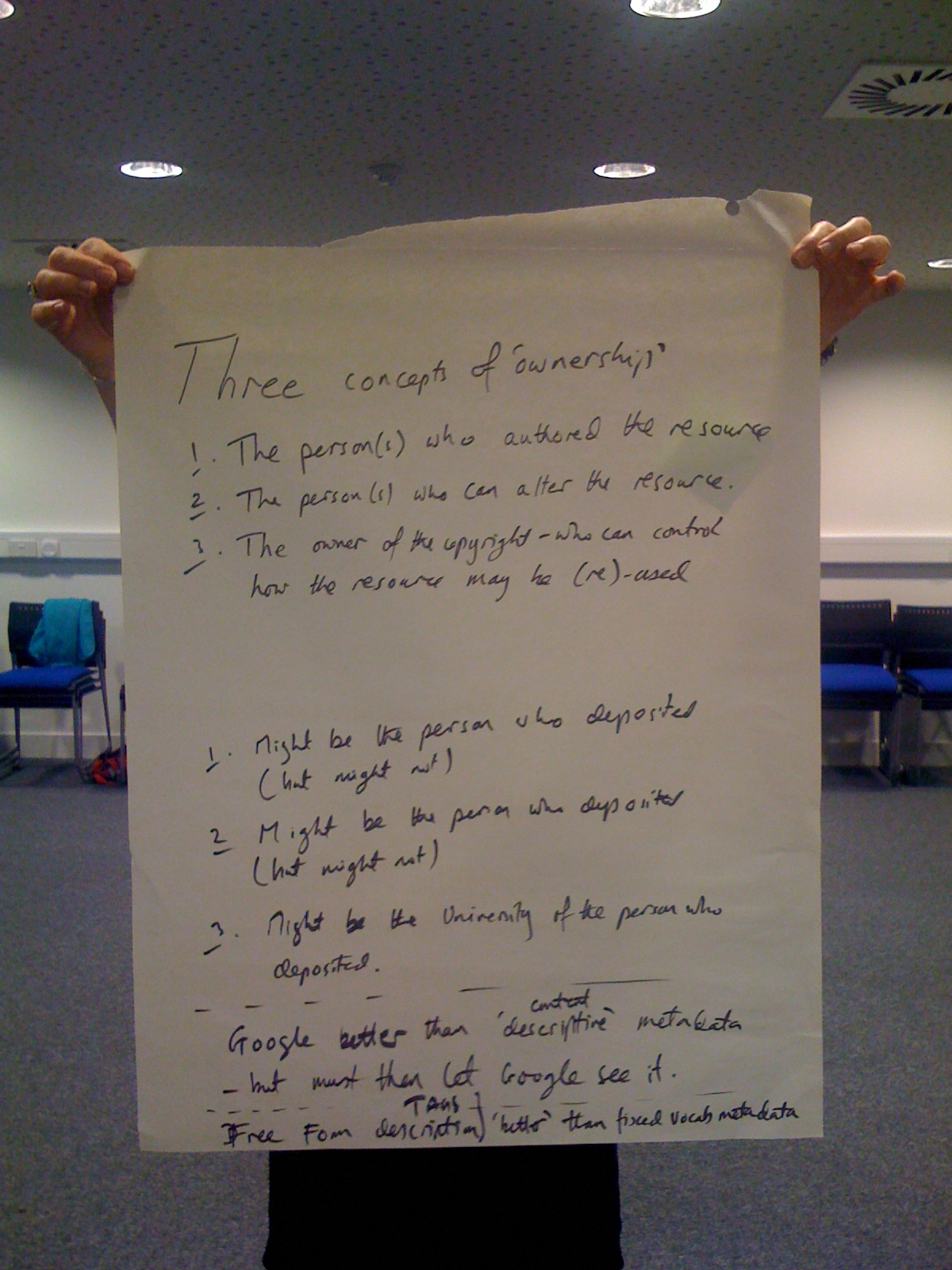
    we made lots of time for group discussions, folk here are considering issues around metadata ( or does it matter data as I like to think of it).

    IMG_1329.JPG


    As you might imagine there is space for a variety of views between the hard line, information scientist formal categorisation


    IMG_1326.JPG


    and the more pragmatic what can be generate automatically,


    IMG_1339.JPG
    and do we need that information anyway, lets just get it tagged by users, kind of approach.

    IMG_1337.JPG


    Ali Dickens from the subject centre for Language, Linguistics and Ares Studies (LASS) is involved in Language Box (for Linguists), and Humbox (for humanities).

    IMG_1333.JPG


    She is planning to run a full day session on copyright on December 14 2009. At our workshop she led a session where she asked folk to do a risk analysis on issues around copyright.


    IMG_1331.JPG


    Its a topic which attracts a lot of interest, and we like to call our interactions with the lawyers on this one poking the dragon. You can see from the flipcharts what we might poke the dragon for.

    IMG_1338.JPG


    the final session of the day was another practical task, using post it notes to look at our favourite web2.0 applications, and think about the technology affordances within those categorisations.

    IMG_1335.JPG


    IMG_1336.JPG


    Tuesday, 26 May 2009

    OER, bootstrapping a culture of change

    Its always heartening to hear that you have a paper accepted, especially when its by an IEEE trans!

    We are really proud of the progress we are making with the EdShare repository of educational resources, and its kid sib language learning repository called Faroes. This paper is looking at organisational learning rather than the nuts and bolts of repositories. It ties in nicely with previous work we have done on barriers and drivers for change. Apart from anything else, if we are going to continue to invest in technology enhanced learning, then we had better find a way from learning on the way about the processes and sharing lessons learnt - for good and for ill!

    Big thanks are due to Hugh Davis who led the insights, corralled us into order, and got this paper off the stocks. Les Carr, aka repository man as ever injects shed loads of energy into our work, and Jessie Hey (now more of a lady of leisure) really had a whole load of experience to share. But (perhaps the secret of our success?) it really was a team effort.

    I wrote a little bit about the context and the background of the paper in a previous post, you may want to take a look at that, and then probably best if I point you to the actual publication.

    Bootstrapping a Culture of Sharing to Facilitate Open Educational Resources
    Davis, H., Carr, L., Hey, J., Howard, Y., Millard, D., Morris, D. and White, S. (2009) Bootstrapping a Culture of Sharing to Facilitate Open Educational Resources. IEEE Transactions on Learning Technologies . (In Press)

    Friday, 20 February 2009

    Bootstrapping the culture of sharing: refining our understanding of learning objects

    or oooer as I like to think about it....

    Bootstrapping a Culture of Sharing to Facilitate Open Educational Resources
    , Davis, H., Carr, L., Hey, J., Howard, Y., Millard, D., Morris, D. and White, S. (2009) Bootstrapping a Culture of Sharing to Facilitate Open Educational Resources. IEEE Transactions on Learning Technologies . (In Press)

    We have been working on a paper for the IEEE Trans on Learning Technologies on some of the cultural change aspects of our experiences of working with repositories. Its about our experience of developing EdShare, but also reflects a rather richer back catalogue of experiences of establishing and using repositories, plus a few insights into the heady world of technology enhanded learning.

    We are really proud of the progress we are making with the EdShare repository of educational resources, and its kid sib language learning repository called Faroes.

    Thanks to shed loads of hard work on scholarly repositories led by Stevan Harnad and Les Carr from right here in ECS at the University of Southampton, we have built ourselves a real track record in that very important area.


    EPrints is an open source repository which has blossomed thanks to the the hard working EPrints team with support from JISC. Our paper is not concerned with the technical aspects of the software, but more importantly about the organisational learning which we have derived from our intense usage of EPrints respoitories - probably most importantly because, compared to other well know repositories, we observe that EPrints users not only install their repository, they actually populate it.

    Here at Southampton we have EPrints repositories for academic publications in ECS, and across the whole institution (University of Southampton). We are also using EPrints to drive our eTheses repository, and our EdShare repository of resources used educationally for teaching and the support of learning.

    We not only have ground level experience of installing and running the repositories, but we are also getting increasingly sophisticated in our understanding of the most effective organisational drivers which can not only get the repository established but also get it used.

    Many different colleagues have identified advantages from using the repositories, each individual will have a personal priority list. Findability figures big on the list. People like to be able to find their own stuff irrespective of moving on to new machines, or new institutions. We also like the fact that items in the repository are findable - classic search engines index the repository, and even if the paper is not world visible, will provide a pointer to its existence, often resulting in individual approaches for further information - thereby enhancing and enriching the scholarly knowledge network.

    well that's enough of me blowing our trumpet, take a look at the paper if you want a little more information, oh and why don't you take a look at EPrints....

    Potential users can find out more about the system and set in train further contactvia the software site hosted at eprints.org

    Friday, 18 April 2008

    Building our EdShare and Sharing educational resources

    Went to our regular weekly EdShare  update and planning meeting today ( http://www.edshare.soton.ac.uk/ ) We are making amazing progress in developing the interface. The basic structure is designed around EPrints ( http://www.eprints.org/ ). Les Carr is leading on EPrints, and he's leading the team, along with Hugh Davis from our Learning Societies Lab.  The project is being funded by JISC as an institutional exemplar. 

    We are working on the principle that academics will be familiar with using a shared space to store their research outputs. We already share educational materials on an informal and ad hoc basis. EdShare is a way of enabling such processes while storing them on a common place. Plus we will be adding tools like tagging to increase their visibility. Early targets are likely to be materials used in teaching which look at generic skills-based areas of the curriculum.  We also planning early sharing of slides used in interactive lectures which use with zappers (personal response systems).