Showing posts with label learning. Show all posts

Wednesday, 31 August 2011

motivating behaviours ....

Very often learning is a by product of exercises which through familiarity enable the learner to internalise understandings and perhaps reflect and abstract from their exerience.
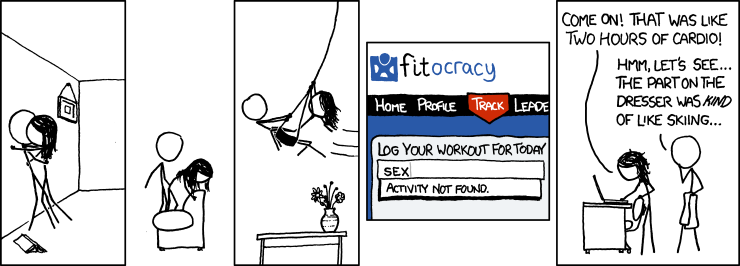
oversight.png
according to the hover over text in the last frame of this cartoon (called Oversight)
"I felt so clever when I found a way to game the Fitocracy system by incorporating a set of easy but high scoring activities into my regular schedule. Took me a bit to realize I'd been tricked into setting up a daily exercise routine"

Systems that motivate
I have also been taken in to play the game on a UK running website called FetchEveryone. Fetch (as it is known to its users) allows you to log your runs and provides quite detailed analysis of your performance (all dynamically calculated from your data). It compares your race performance with national standards, and applies known reckoning methods to predict performance in future races.
Early additions included adding a personal annual challenge and generating league tables against the target. Then, noting that folk tended to set challenges (particularly of the do something every day for a month - in running terms known as streaking, and typcially titled something like AugustAthon, MayAthon (or whatever month you choose) it established a feedback grid called a ThingyThon.
It also introduced a game called Conquercise, which is a Foursquare or Gowalla for runners, allowing them to 'conquer' areas as a result of being the person who covered a particular grid square the most frequently.
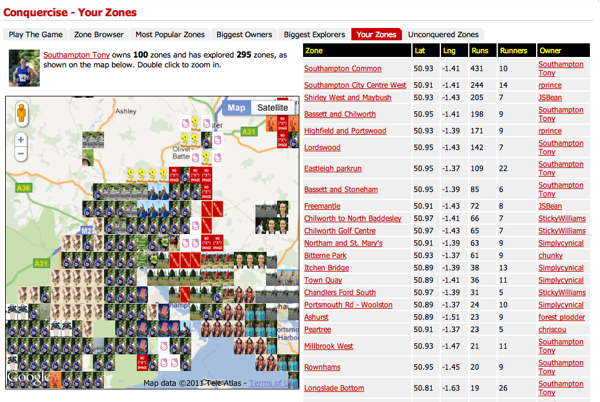
FetchEveryone Conquercise Southampton

One of the aspect of learning (which is related to motivation) is time spent on task. All of the examples above reward people for spending more time on task. The reward is personal, but the recognition and status is within the community.

This reward for persistent behaviour is a factor which runs as a thread in various commentaries on social media - for example Charles Leadbeater's We Think, and Clay Shirky's Cognitive Surplus.

Pervasive monitoring
For exercise activities various pervasive monitors have emerged which take some of the over the tasks of data collection.
Fitbug is another example of such a system - a glorified pedometer from which to upload data, ie designed for a specific purpose, this time using a subscription model (perhaps further motivation??) and running a closed system - although it does incorporate league tables (a fantasy footfall league!). Fitbit is more sophisticated measuring activity levels with a 3d motion detecter. It only available in the US but lets you choose between subscription and free use plus it is making its API available for interface with other apps (although data download is only available with the subscription model).
Systems such as Fetch allow you to submit data collected automatically by specialist devices such as heart monitors and GPS tracking systems. It appears, superficially, that folk who are able to submit such data are more persistent in their updates, and perhaps, more persistent in their commitment to exercise. That is certainly the claim which is made for the Fitbug.

Games with a purpose
Games with a purpose have a long history. According to The British Library the first jigsaw puzzles were devised by John Spilsbury to help teach geography (1776) , make a map of the worlds and you kind of get familiar with the different countries, towns and where  they all are.

Monitoring for learning
I am particularly interested in the way in which social software is being harnessed to reinforce behaviours. My thinking is that this might be extended to motivating time on task for our undergraduate students. I am not aware of any other systems which are currently operating along these lines.
My challenge is to work out how to devise a game which would be appropriately motivating, and how create a closed and trusting community which would enable personal data to be aggregated for individual and  group advantage. My thinking is that students themselves are likely to be the best people to design such a system, using their understandings to build something which is appealing and purposeful.
In many ways a good system would provide data which could be examined to provide guidance for subsequent learners addressing similar tasks.  The Fetch system administrator performs and publishes this type of analysis and distributes the findings in regular newsletters - an example them of citizen science which is gathering data on a larger scale and from larger cohorts than is often available for academic sports scientists.
Using tracking derived from Educational administration and infrastructure might provide some of the means by which we could allow learners to submit data automatically to an educational version of Fetch.

Links

Saturday, 30 October 2010

Readings digital literacies

- things have moved on since I gathered this set of references....
so probably best to search for some updates

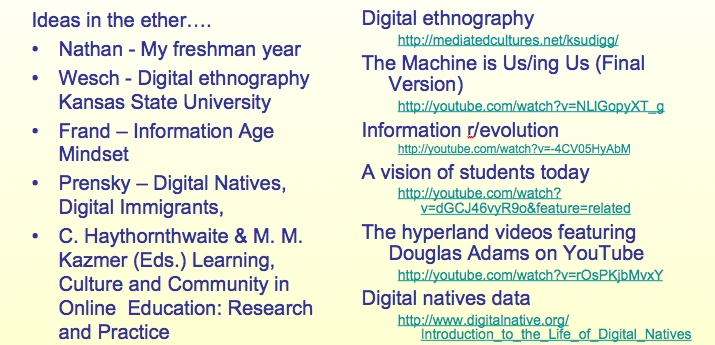
Thankfully a lot of work has refuted the claims for digital natives :-) the world has moved on....

Picture 92.png


If nothing else, they reflect some of the ideas I am still coming across, I know that there have been a number of JISC publications, the learner experience work, and also Helen Beetham's work on Digital Literacies (refs needed)


Frand, J. L., "The Information Age Mindset: Changes in Students and Implications for Higher Education," Educause Review, vol. 35, pp. 15–24, 2000.
Haythornthwaite, C. A. and Kazmer, M. M., Learning, Culture, and Community in Online Education: Research and Practice: P. Lang, 2004.
Nathan, R., My Freshman Year: What a Professor Learned by Becoming a Student: Cornell University Press, 2005.
Prensky, M., "Digital Natives, Digital Immigrants," On the Horizon vol. 9, pp. 1-6, 2001.
Prensky, M., "The Emerging Online Life of the Digital Native: What They Do Differently Because of Technology, and How They Do It " Games2train, http://www.marcprensky.com/writing/Prensky-The_Emerging_Online_Life_of_the_Digital_Native-03.pdf 2004.
Wesch, M., " What Is Web 2.0? What Does It Mean for Anthropology? ," Anthropology News vol. 48, pp. 30-31, 2007.
Wesch, M., "Youtube Ethnography Project," Kansas State University http://mediatedcultures.net/, 2007.

Wednesday, 9 June 2010

readings: technology enhanced learning

If you are looking to understand where some of my current ideas on TEL and Rich Learning Environments are coming from you might like to look at the following foundational texts and papers. Mostly they are not especially recent, but they do provide a framework for understanding.
The important thing is to look at the beginnings and then consider how these ideas and approaches have been developed in the future. It may also be worth looking at the most recent edition of any work and finding out from the introductions how and why the revisions have been made.


ANDERSON, L. W., KRATHWOHL, D. R., AIRASIAN, P. W. & CRUIKSHANK, K. A. (Eds.) (2001) A Taxonomy for Learning, Teaching, and Assessing: A Revision of Bloom's Taxonomy of Educational Objectives, New York : Longman
BEETHAM, H. & SHARPE, R. (Eds) (2007) Rethinking pedagogy for a digital age. Oxford: Routledge, Falmer
BIGGS, J. (2003) Teaching for Quality Learning at University, Maidenhead, Society for Research into Higher Education/Open University Press.

BLOOM, B. S. (1956) Taxonomy of educational objectives; the classification of educational goals, New York, Longmans.

BLOOM, B. S. (1984) The 2 sigma problem: The search for methods of group instruction as effective as one-to-one tutoring. Educational Researcher, 133-16.

GAVER, W. W. (1991) Technology affordances. Proceedings of the SIGCHI conference on Human factors in computing systems: Reaching through technology. New Orleans, ACM Press.

GAVER, W. W. (1996) Situating Action ii: Affordances for interaction: The social is material for design. Ecological Psychology, 8111-130.

JONASSON, D. H., MAYES, J. T. & MCALEESE, R. (1993) A manifesto for a constructivist approach to uses of technology in higher education. IN DUFFY, T. M., LOWYCK, J. & JONASSEN, D. H. (Eds.) Designing Environments for Constructivist Learning. Berlin, Springer Verlag.

LAURILLARD, D. (1993) Rethinking University Teaching: a Framework for the Effective Use of Educational Technology, London, Routledge.
this work spawned a wide range of approaches to TEL which incorporated or developed the conversational model of learning
LAVÉ, J. & WENGER, E. (1991) Situated learning: legitimate peripheral participation Cambridge University Press
this was first published in 1990 as a report from the Institute for Research on Learning report 90-0013
MARTON, F. & SÄLJÖ, R. (1894) Approaches to learning. IN MARTON, F., HOUNSELL, D. & ENTWISTLE, N. (Eds.) The experience of learning. Edinburgh, Scottish Academic Press.

MAYES, J. T. (1995) Learning Technology and Groundhog Day. IN STRANG, W., SIMPSON, V. & SLATER, D. (Eds.) Hypermedia at Work: Practice and Theory in Higher Education. University of Kent at Canterbury, University of Kent at Canterbury.

MAYES, T. & de FREITAS, S.  (2006) Review of e-learning theories, frameworks and models JISC e-Learning Models Desk Study. Bristol, JISC.

O'REILLY, T. (2005) What Is Web 2.0 – Design Patterns and Business Models for the Next Generation of Software http://oreilly.com/web2/archive/what-is-web-20.html.

O'REILLY, T. ( 2007) What is Web 2.0: Design Patterns and Business Models for the Next Generation of Software. Communications & Strategies, 1: First Quarter 2007,17.

Rich Learning Environments - what do they mean

Picture 28.png
This post revisits some of the discussions from previous posts which looked at a definition of rich learning environments
I would like to set it in the context of changes which continue to take place as the use of technology in everyday life.

My previous post Rich Learning Environments laid out a basic framework for our emerging understanding of the needs and behaviours of existing students and learners.

What is in the background?


Affordances Perspective


Any discussion of technology for learning to my mind has to start with Gaver and a consideration of what (not necessarily intended) consequences the presence, use and availability

Picture 29.png

Affordances of Web 2.0 and the Social Web


Another reference point of which we can usefully be aware, was the definition of Web2.0 which O' Reilly initially addressed at conferences, workshops and through blog publications - and which was subsequently published

What is interesting here is that we can think about Rich Learning Environments as realising all of the core features which O'Reilly associates with Web2.0

• the web as a platform

• you control your own data

• services not packaged software

• architecture of participation

• cost-effective scalability

• re-mixable data source and data transformations

• software above the level of a single device

• harnessing collective intelligence


Picture 39.png


http://oreilly.com/web2/archive/what-is-web-20.html#mememap


A little bit of Education


A recent interesting view which has been developed by school teacher Andrew Church in New Zealand, is an eduationalist's perspective ( termed 'Bloom's Digital Taxonomy' ) which considers the impact or affordances of technology which have recently come into use.


References


GAVER, W. W. (1991) Technology affordances. Proceedings of the SIGCHI conference on Human factors in computing systems: Reaching through technology. New Orleans, ACM Press.

GAVER, W. W. (1996) Situating Action ii: Affordances for interaction: The social is material for design. Ecological Psychology, 8111-130.

O'REILLY, T. (2005). What Is Web 2.0 – Design Patterns and Business Models for the Next Generation of Software http://oreilly.com/web2/archive/what-is-web-20.html. last accessed June 2010


O'REILLY, T. ( 2007) What is Web 2.0: Design Patterns and Business Models for the Next Generation of Software. Communications & Strategies, 1: First Quarter 2007,17. http://papers.ssrn.com/sol3/papers.cfm?abstract_id=1008839 last accessed June 2010

Thursday, 6 May 2010

Learning and Studying with Technologies - TELUSS

We can expect students at University to use a whole range of technologies in many different ways to help them learn and study for their degrees.

Academics are likely to be interested in this from two separate, but inter-related perspectives

1) Big Picture

What is the big picture view of current practice and the implications of this for the future long term development of practice in Higher Education?

2) Local Practice

What are the current practices and needs of our existing students in our own institutions - and how does this look compared to the big picture?

Hype vs Hope ( and truth and reality)

In addressing this we need to be able to :

sort out the hype of behaviours

challenge headline grabbing ideas and stuff that sells books

Beware of the hyperbole of moral panic, alarmism, and generalisations based on the leisure habits of time-rich young people

Find evidence from the reality of practice


Remember that


The behaviours of our students are likely to be constrained by time and driven by pressing imperatives

The needs and purpose of university education includes introducing learners to new ideas, and equipping them with multiple literacies, not least digital literacies


Question:
You probably already use technology in many different ways to help you learn and study for you university degree what three changes would you suggest the University introduce which would make a real difference to that aspect of your study at Southampton.

Monday, 7 December 2009

Rich Learning Environments - Education 2.0 or 3.0?

rle.jpg


I have been working on various applications of technologies for learning for many years now. Along the way, I've been developing an idea of what I mean by a rich learning environment.

Rich learning environments are dynamic spaces which bring together personalised information and perspectives across a core of resources which can support the learner in addressing their educational needs. Rich learning spaces exploit the technology affordances of their component parts, but provide added value by simplifying and customising the interface to a set of complex and diverse resources based on a learners context and education needs.

These needs might be categorised into four broad areas personal space; institutional space; support space; and 'good for learning' space

Personal Space:
A learner will already make use of their own preferred tools and applications which may be used either in addressing the demands of formal learning (for example using google docs to create a word processed document) or informal learning (using delicious to store and find information and resources on topics related to study). Each learner will have (most likely) their own machine(s) (laptop, desktop, mobile (?) and within that operating system will have selected and be familiar with a set of tools. Some parts of this (e.g. Skype, text messaging) may not be clearly linked or associated with learning tasks, but none the less may be of great importance to the student.

Institutional Space.
The institution which the learning is studying in, or at which the learner proposes to study, will have 'spaces' which have a role in informal or formal learning and learning support. It is possible that the set of spaces will change during the learners route through education with the institution.]sites/sources will be of verying importance at different times.
At southampton you may have a number of discrete spaces - e.g. UOS web, ECS web, ECS web behind the firewall, Sussed, blackboard challenges some of these are password protected, vpn protected etc

Support Space
dependi8ng on the context of the student, there will be external spaces which mught be of use/relevant to formal and informal learning - e.g. In Southampton the SUSU.org web site provides additional information and support, for international students it may be that their home country embassy site, or some home office sites may be of importance

'Good for learning'
Students may benefit from information and resources which are located outside their current personal space, and outside the institutional space. For example the National Union of Students offers support and advice related to study and examinations. There are other sources of information (appoaches to leawrning inventories, second language study).

Social Space
underpinning the environment there is an integrating layer provided by social space. This incorporates email, messaging, and social software. It acts as the glue for the environment.

If we consider student whose topic of study is technology based, it may be that we could identify a set of sources/resources which could enrich the users perspective, but which are not obvious;y initially related to learning. E.G. In computer science/web technologies, maybe Zdnet, Slashdot, british computer society, ACM digital library, IEEE digital library it may be that a set of resources could be identified which are relevant and helpful to the rich learning environment user, which could usefully be integrated into a customised environment.

Challenges

Creating a rich learning environment presents a number of challenges

Integrating a set of resources to become an apparent coherent whole.

Offering personalisation and customisation of an environment so that it enables the user to retain use of their preferred tools, but also that it perform and educational function of supporting the learning

Providiung innovative and user friendly methods of accessing and overseeing (and perhaps organising/re-organising) complex information sources.

There is a challenge of how to customise the environment (at first use, during the course of use)

Wednesday, 29 July 2009

Back To School

IMG_0783.JPG

Its always good for a teacher to go back to school. This year, in anticipation of setting up a sabbatical at a French University, I decided to go back to school and brush up my French. I was fortunate, in that I was going to be in Paris for a conference in any case for a conference.

Maybe its my personal preference, but I found a couple of weeks intensive study an excellent option. It gave me a chance to focus and refine my understanding, and once again I found myself musing on ways we could take an intensive approach in our regular courses at University.

So what was their recipe for success?
  • small classes with expert tuition
  • highly motivated learners
  • intensive, highly focussed topic area

Tuesday, 26 May 2009

OER, bootstrapping a culture of change

Its always heartening to hear that you have a paper accepted, especially when its by an IEEE trans!

We are really proud of the progress we are making with the EdShare repository of educational resources, and its kid sib language learning repository called Faroes. This paper is looking at organisational learning rather than the nuts and bolts of repositories. It ties in nicely with previous work we have done on barriers and drivers for change. Apart from anything else, if we are going to continue to invest in technology enhanced learning, then we had better find a way from learning on the way about the processes and sharing lessons learnt - for good and for ill!

Big thanks are due to Hugh Davis who led the insights, corralled us into order, and got this paper off the stocks. Les Carr, aka repository man as ever injects shed loads of energy into our work, and Jessie Hey (now more of a lady of leisure) really had a whole load of experience to share. But (perhaps the secret of our success?) it really was a team effort.

I wrote a little bit about the context and the background of the paper in a previous post, you may want to take a look at that, and then probably best if I point you to the actual publication.

Bootstrapping a Culture of Sharing to Facilitate Open Educational Resources
Davis, H., Carr, L., Hey, J., Howard, Y., Millard, D., Morris, D. and White, S. (2009) Bootstrapping a Culture of Sharing to Facilitate Open Educational Resources. IEEE Transactions on Learning Technologies . (In Press)

Friday, 20 February 2009

Bootstrapping the culture of sharing: refining our understanding of learning objects

or oooer as I like to think about it....

Bootstrapping a Culture of Sharing to Facilitate Open Educational Resources
, Davis, H., Carr, L., Hey, J., Howard, Y., Millard, D., Morris, D. and White, S. (2009) Bootstrapping a Culture of Sharing to Facilitate Open Educational Resources. IEEE Transactions on Learning Technologies . (In Press)

We have been working on a paper for the IEEE Trans on Learning Technologies on some of the cultural change aspects of our experiences of working with repositories. Its about our experience of developing EdShare, but also reflects a rather richer back catalogue of experiences of establishing and using repositories, plus a few insights into the heady world of technology enhanded learning.

We are really proud of the progress we are making with the EdShare repository of educational resources, and its kid sib language learning repository called Faroes.

Thanks to shed loads of hard work on scholarly repositories led by Stevan Harnad and Les Carr from right here in ECS at the University of Southampton, we have built ourselves a real track record in that very important area.


EPrints is an open source repository which has blossomed thanks to the the hard working EPrints team with support from JISC. Our paper is not concerned with the technical aspects of the software, but more importantly about the organisational learning which we have derived from our intense usage of EPrints respoitories - probably most importantly because, compared to other well know repositories, we observe that EPrints users not only install their repository, they actually populate it.

Here at Southampton we have EPrints repositories for academic publications in ECS, and across the whole institution (University of Southampton). We are also using EPrints to drive our eTheses repository, and our EdShare repository of resources used educationally for teaching and the support of learning.

We not only have ground level experience of installing and running the repositories, but we are also getting increasingly sophisticated in our understanding of the most effective organisational drivers which can not only get the repository established but also get it used.

Many different colleagues have identified advantages from using the repositories, each individual will have a personal priority list. Findability figures big on the list. People like to be able to find their own stuff irrespective of moving on to new machines, or new institutions. We also like the fact that items in the repository are findable - classic search engines index the repository, and even if the paper is not world visible, will provide a pointer to its existence, often resulting in individual approaches for further information - thereby enhancing and enriching the scholarly knowledge network.

well that's enough of me blowing our trumpet, take a look at the paper if you want a little more information, oh and why don't you take a look at EPrints....

Potential users can find out more about the system and set in train further contactvia the software site hosted at eprints.org

Monday, 9 February 2009

Reflection, learning , careers and employability

The problem
Put stuff to do with careers and employability on the curriculum and you are guaranteed to have the students in revolt before you can blink your eyes. I have already been working on ways of making the educational side of this process better for the students, This year I have an opportunity to try to make some innovations which impact on assessment and feedback.

Introduction: My Situation
This week those two agendas have bubbled to the surface in an interestingly counterposed manner

1) I am tasked with 'teaching' students to complete reflective portfolios which I will later mark

This is a task and a subject area which they often hate with a passion;
think is a waste of time and would generally dump in preference for getting on with some meaty topic which they perceive as being relevant to their chosen degrees.


2) I am tasked with working with colleagues to develop our employability agenda across and within the curriculum

Things which are easy to do may be totally ineffectual as far as the students who need assistance are concerned.
Many of our students are highly employable, and willingly develop their own employability skills out of class, we have good general employment rates.
Those students who have difficulties may be self consious, odd, shy, lacking in self confidence, confused, or generally struggling. Such students may not respond to additional structured activities, and we are to be advised to design any such activities with great care


Portfolios

The portfolios the students will create are structured to help them with their learning ( a practical task) but are also seen to be relevant to the careers and employability agenda. I am shuddering at the whiff of the letters PDP, and of course the students have a lot of baggage in that area as well. School portfolios and skills classes mean this is a very difficult area of the curriculum. I am having to work hard to help the students understand what might be in it for them, beyond a few marks for a fairly simple task, which gets them a little closer to the end of their degree. I think the processes have great value, I am not however convinced about the outputs. Let me expand...

Some ethical considerations

I have a few ethical concerns which are in the area of the process of reflective logs and portfolios generally. Different people will reflect in different ways. Students need a great deal of self confidence plus the sense of personal safety to be able to reveal their inner thoughts on their successes and failures in writing.

Faced with the prospect of answering/interpreting a series of short questions to put into a document to be potentially ripped apart by the critical eye of an academic, many of them take an opt out of this activity and rather than offering reflections, offer bland statements which distance themselves from the process, and protect themselves from any harm.

My Dilemma
I am not sure it is easy to award a fair mark for such a personal activity. Students rely on clear assessment criteria to assist them in objective tasks, but clearly reflection and creating a reflective portfolio is highly subjective.

This puts me in a difficult position. What am I to do? How should I mark these portfolios? Should I mark the portfolios? Surely the fact that they are marked will change their purpose?

Last year I read each portfolio, constucted an individual mark which was based on what I understood to be the level of engagement based on the content with which I was presented. I was not sure when I marked each portfolio, from what base each student was starting.

I constructed some generic feedback, and sent this to all the students. Each portfolio had some individual comments, I was wary of being hurtful to the individuals, bit I tried to provide constructive feedback and criticisms.

So.... this year we are asking another cohort to produce portfolios. For the marking I will be:
  1. meeting with each student individually for 10 minutes to discuss their portfolio
    .... for some reason I was suddenly reminded of a recent rather unsatisfactory appraisal meeting....
  2. The meetings will be videod for moderation purposes and quality assurance.
  3. I am thinking of making an audio recording of each session which I mail to the student at the close of the discussion, so that they have their own record of the proceedings.
  4. I will produce a generic feedback document for this cohort

Discussion points
It will be interesting to see how I can streamline the process, from the point of view of producing the audio and video, making sure it is indexed and analysing what the students' perception of the process compared to their previous experiences - quite a few methodological challenges in that little bit, never mind the technology.

I hope that my personal awareness will serve the students well. I suddenly have another memory, this time of a comment from a one-time vice chancellor at another university. "We deal with student's life chances, we don't have the right to fuck them up"!

It may be that the already self confident fill in such forms with ease and as a result get a good mark, but I do not believe that their ease with the task will help the employability of the whole cohort. We are working with engineering students. We have a high level of dislexia across our student cohort. I had a student close to tears today because of some comments he had received on a previously submitted portfolio.

The good bit
I suppose because I am sensitive to the possible shortcomings, and I do care about how the students benefit, I will bring these considerations to bear in our school planning and discussions.

Wednesday, 28 January 2009

Digital Native Myth or Reality?

Just yesterday I posted a Twitter reply to a friend's message stating that I thought the digital native/generation X/ Baby Boomer was an ill thought shorthand rather than anything based in reality.

Its a concept which we have touched upon in seminars in the Learning Societies Lab, especially in presentations from Dave Millard (LSL) and Linda Creanor (Caledonian Academy)

Today, I am checking out a friend's blog via Twitter, and hey ho I discover that my assertion is being to be backed up by a bit of evidence.

Better still I am going to be gathering evidence from my own institution (University of Southampton) looking at students' experiences and perceptions of technology in learning over the next few week and months for a which will contribute to a study (LLiDA) being run to follow this up.

From our perspective in Southampton, its also a follow up to the work we did on the benchmarking of eLearning. Benchmarking was interesting for a number of reasons, the data we gathered, and the methodology we used (EMM), our cohort which compared findings across the methodology, and some analysis of our perspective of a research intensive university.

So if you want to follow some of this through go take a look at the good work of folks in the Caledonian Academy and their Latest Thinking and which has a link to the paper by Anoush Margaryan and Allison Littlejohn.

Friday, 14 November 2008

L-TAGS

Learners and Technology Affordances Group
I really like the perspective of technology affordances and always go back to Gaver’s paper to remind myself where the technology part of the affordances discussion originally came from.

So wayback I was involved in a project which produced some guidance of students using technolgy in learning. What I am trying to do is revisit that work and look at it with modern eyes.

Amongst the ideas which emerged then were an activity gradient - looking at different styles of interactions. I visited each area of the gradient and came up with lots of examples for each stage in the gradient. Not sure where it is now, but I do know that I don’t throw stuff away....

Also Hugh Davis and I produced a (rather clunky) slide show which looked at a day in a life of a student - and showed a few scenarios.

What I want to do now is to make a start on re-populating the stages in the gradient and add in the applications which have emerged since the work we originally did. I am planning to start by populating it myself, but then putting it up onto a wiki and getting people in workshops to elaborate it with me.

Since then too, I have got very much into the ideas of disciplinary differences and have been looking at how teaching and student learning varies across disciplines - and given my home area, of course I have quite a lot of stuff on Computer Science, engineering, technology and cognated disciplines.

These ideas link to work which we are doing on student experience following on from our campus benchmarking exercise in 2007-08. I took these ideas to COOP 2008 and they also link in to the proposal I have just put forward to the ALT2009 Programme Committee to run a student YouTube competition for short videos on the theme of their perceptions of learning.

I guess part of the idea for a YouTube competition came from the Guardian who are running something on this theme with a deadline for December 2008. Its also inspired by some of the whacky videos which our own students via the Student Union at Southampton have produced recently.

Maybe we could put a video-booth on campus which students could use, maybe we should involve the students union who ran the freshers TV stuff. Dave Tarrant is our ECS TV PhD person who may be worth talking to, Jason Allen is an undergrad in ECS who has done Freshers TV.

Not sure how this would work, but if could be an adjunct to the student voices work we are just getting off the ground.

Tuesday, 4 November 2008

Back in the loop - rant

OK
back in the blogosphere, but not sure for how long
desperately grappling with my online identities
am I a runner?
am I an academic?
am I just plain eccentric?

what I do know is that I have not posted since September partly because I have been doing other things, but also partly because each time I tried to post, the text appeared in Hindi! this was not my intention, but its taken til now to spot the transliteration button at the bottom on the config page and work out that I needed to change it - not that I spent a great deal of time on it you understand, but still it was a barrier

  • And that is what I am interested in from a research point of view.
  • I came back to this blog because I have been editing my home page, and then thinking it would be better to do this via the blog.
  • And then that added another item on the todo list ( which I am currently ignoring) which is that I probably need to separate my online identities.
  • And then that made me think about the fact that I maybe want to register a few more domain names
  • And that reminded me that each domain will need a visual identity
  • and that made me think about a life online, and the fact that I only live it a bit, because I also have a life offline....
phew...
and did I mention the really good pages from British Columbia on digital tatoos?
But coming back to the life online, there are a few ideas....

If we are talking about using technology for education, we might need to think about the realities of people's lives.

Academic researchers who live online have a world view which is shaped by their experience, but it aint the world view of joe and joanna public.

I have a list of considerations:
remember:
  1. your students do not have the same priorities as you do
  2. it might be dangerous to base our models of how students prefer to learn of the leisure habits of an indeterminate number and proportion of young people
  3. early adopters and early majority have a different experience/perspective to the late majority
  4. educators need to take charge of how they go about educating
  5. the bandwidth of face to face communications can be incredibly high
  6. its a good idea to remove the barriers to learning
  7. learning can only be done a bit at a time
  8. the magic number seven plus or minus one was a good paper, but we might be happier with even less complexity
  9. the map is not the teritory
  10. academic evangelists do not have the same perspective as neophyte learner
Now of course, the technogazers have a valid argument that you should not focus on the implementation problems, but think about the big picture, however, if we are dealing with education here and now, then the human issues actually do matter. So as a future gazer I can say, discount the problems, but as a teacher using the technology I need to understand the problems in order to overcome them. That means, logically that the problems need to be categorised accoding to their impact - half life - will it go away in time if so, how does that change things? does the exisitence of the problem give us insight into something which is important - ie and insight into the learning process?

When I was going through my dilemma of am I a runner/academic/eccentric I was also thinking that its important that I am all of these things.

Talking to my running sisters reminds me that there are lots of people who are not online all the time, do not have routine access, and who have rather clunky models of how inter-webby thing might work. We could think of them affectionately as the world wide plebs
Plebs - definition from the free dictionary
common people, folk, folks - people in general (often used in the plural); "they're just country folk"; "folks around here drink moonshine"; "the common people determine the group character and preserve its customs from one generation to the next"

so here we are back in the life online
some of us have one, some of us don't... some of us who do, are not there all the time

and I am coming back to some old ideas - technology affordances, barriers to learning hmmm...

Thursday, 8 May 2008

Towards a Theory of Education 2.0


I'm very excited about the workshop at the COOP '08 conference I am attending late in May. I went along to the eduserv symposium because I thought it would help focus me on what's happening right now.

The symposium was quite wide ranging and it has helped me think about how I need to make some aspects of my argument more specific and associated with curriculum 

Wanting to pull some ideas together for towards a theory of education 2.0.

Think I will address it specifically from perspectives of situated learning, authentic learning, and informal learning.

Also need to take a view which comes from Gaver's classic perspective of technology affordances

Sort of ties up with the VLE is dead perspective from Martin Weller

Also takes some guidance from Dave Millard's work on 2.0 applications

Needs a few diagrams to map the space